But God…

Silhouette of hands holding a glowing cross against a sunset sky.

I Like Big Buts and I Cannot Lie

But God.

Those two words might be my favorite words in all of Scripture — and honestly, my favorite concept for how life actually works.

Let me explain.


A Song That Wouldn’t Leave My Head

Album cover of Sir Mix-A-Lot's 'Baby Got Back' featuring the artist in a black outfit and sunglasses, standing against a blue sky with a large red heart at the bottom.

In 1986, a hip hop artist named Sir Mix-a-Lot released a song titled “Baby Got Back.” It’s a song that still gets played in certain circles from time to time, and it opens with a line most of us could finish without help:

“I like big butts and I cannot lie…”

The song is obviously talking about body parts. But as I was preparing this word, that opening phrase came to mind — because that same sentence applies to most of us, just in a completely different way.

Think about how often your own inner monologue sounds like this:

  1. “I would go work out today, but I’m too tired.”
  2. “I want to talk to my friend about this issue, but I don’t like confrontation.”
  3. “I want to do great things, but I’m too old.” (or too young)
  4. “I would do [whatever it is], but [insert any excuse you own].”

Do you see what’s happening? Every time we follow a statement with the word but, we erase everything that came before it. The but swallows the sentence.

And in real life, that little word gets big. Life inflates the but until it looks like a wall — and that wall keeps us from doing the things we know we should do, the things we were made to do.

Well, I want to tell you something: it’s time for all of us to get off our buts.

Because the next time you catch yourself saying but, you have the option to follow it with something else entirely.

But God.


The Two Words That Change Everything

An open book with a blue cover and a golden spine, displaying the text 'But God...' in a playful font against a dark background.

When I say “But God” is my favorite phrase in the Bible, I’m not exaggerating. I love it because of what it always does. It never appears in Scripture to cancel hope — it appears to redirect it. Just look at how it shows up:

  • Genesis 50:20 — “You intended to harm me, but God intended it for good to accomplish what is now being done, the saving of many lives.”
  • Psalm 49:15 — “But God will redeem my life from the grave; he will surely take me to himself.”
  • 1 Corinthians 1:27 — “But God chose the foolish things of the world to shame the wise; God chose the weak things of the world to shame the strong.”
  • Ephesians 2:4-5 — “But God, being rich in mercy, because of the great love with which he loved us, even when we were dead in our trespasses, made us alive together with Christ — by grace you have been saved.”
  • Matthew 19:26 — Jesus looked at them and said, “With man this is impossible, but with God all things are possible.”

Every single time, someone had reached the end of their own strength. Someone had filled in the blank after the but with a dead end. And God stepped in and rewrote the sentence.


Mercy and Grace: The Engine Behind “But God”

Silhouette of three crosses against a dramatic sky with dark clouds and lightning.

Here’s what makes the whole thing work: it rests entirely on God’s mercy and grace.

Those two words get used interchangeably, but they’re not the same thing. Here’s the clearest way I know to put it:

  1. Mercy is God not punishing us as our sins deserve. It’s deliverance from judgment. It’s God not giving us what we do deserve.
  2. Grace is God blessing us despite the fact that we don’t deserve it. It’s extending kindness to the unworthy. It’s God giving us something we don’t deserve.

Mercy says, “I won’t give you what you’ve earned.”
Grace says, “I’ll give you what you never could have earned.”

And when those two work together, you get a But God statement. There are countless things we have access to because of it — but today I want to look at just three.


1. God’s Mercy and Grace Give Us Salvation

A dusty dirt road stretches into the distance, surrounded by sparse vegetation and distant mountains under a partly cloudy sky.

Titus 3:5 — “Not by works of righteousness which we have done, but according to his mercy he saved us, by the washing of regeneration, and renewing of the Holy Ghost.”

Ephesians 2:8-9 — “For you are saved by grace through faith, and this is not from yourselves; it is God’s gift — not from works, so that no one can boast.”

The apostle Paul knew he had received God’s mercy, and he knew full well he didn’t deserve it. But God — the most wonderful two words ever put together — gave it to him anyway.

You see, Paul made a lot of mistakes before he was saved. He was essentially an old-time Charles Manson, responsible for the death of a lot of Christians. Then one day, on the road to Damascus, Paul received God’s mercy instead of the judgment he deserved. Not only that — grace was given to him too. A new name (Saul became Paul). A new life. A new mission. None of it based on anything he could boast in.

He was forever thankful. And so am I.


2. God’s Mercy and Grace Give Us Help in Times of Trouble

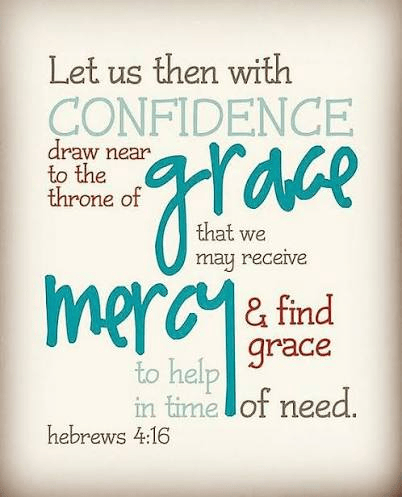
Hebrews 4:16 — “Let us therefore come boldly unto the throne of grace, that we may obtain mercy, and find grace to help in time of need.”

Artistic text design featuring the Bible verse Hebrews 4:16, emphasizing themes of confidence, grace, and mercy.

We all face difficult, trying seasons. If you’ve lived very long at all, you’ve cried — I know I have. But there is good news: the help and comfort we need is always available during those times, and it’s all because of God’s mercy and grace.

Nobody has earned the help God gives us each day. Honestly, we all deserve to reap the results of our bad choices without any comfort at all. You’ve probably heard the phrase, “You made your bed, now lie in it.” We do find ourselves in trouble because of our own choices sometimes — but God shows mercy by not leaving us alone, and then shows grace by giving us help anyway.

What have any of us done for God lately that He owes us a favor? He is God. He doesn’t need anything from us. Everything we’re given is because of His loving grace and mercy.

I’m so thankful for the blessings God gives me — especially the ones I never earned.


3. God’s Mercy and Grace Give Us Strength to Endure

A climber ascending a rocky mountain with a sunset backdrop, showcasing determination and adventure.

2 Corinthians 4:1 — “Therefore, since we have this ministry because we were shown mercy, we do not give up.”

Philippians 4:13 — “I am able to do all things through Him who strengthens me.”

The Berean Literal Bible puts it this way: “I have strength for all things in the One strengthening me.”

Sometimes life gets so stressful it feels like we can’t make it through one more day. But there is good news: we are not alone. God’s mercy and grace strengthen us and sustain us so we don’t have to give up. We can endure whatever comes our way because He gives us strength and walks through it with us.

We may feel alone, abandoned, too weak to make it — but God never leaves us or forsakes us. We have a friend in Jesus, a friend who sticks closer than a brother. When it seems like we can’t go another step, He tells us to cast our cares on Him, because He cares for us. His mercy and grace are new every morning, always available.


The Man Who Built the Thing

A man in a coat and bowler hat stands beside an early 20th-century car, with a crowd in the background.

I want to share a short story about Henry Ford.

One day Ford was driving through the Michigan countryside when he saw a man whose Model T had broken down alongside the road. Mr. Ford stopped and asked if he could take a look and see if he could fix it. The man said yes. In just a matter of minutes, Mr. Ford had the car running again.

The man told him he sure was impressed. Henry Ford replied, “Well, I should be able to fix it — after all, I’m the one who designed it.”

God designed us. And whatever might be wrong with us, God is able to fix it. There is nothing God cannot do.

So the next time life throws you something that makes you pause and start a sentence with but — I want you to remember the biggest but of all.

But God.

Go to Him. Take advantage of His mercy and grace today.

It turns out I really do like big buts. And I cannot lie.


More “But God” Verses to Study

If you want to go deeper, here are a few more of my favorites:

  • Genesis 8:1 — “But God remembered Noah and all the wild animals and the livestock that were with him in the ark, and he sent a wind over the earth, and the waters receded.”
  • Genesis 31:42 — “…But God has seen my hardship and the toil of my hands, and last night he rebuked you.”
  • 1 Samuel 23:14 — “Day after day Saul searched for him, but God did not give David into his hands.”
  • Nehemiah 9:17 — “…But you are a forgiving God, gracious and compassionate, slow to anger and abounding in love. Therefore you did not desert them.”
  • Psalm 73:26 — “My flesh and my heart may fail, but God is the strength of my heart and my portion forever.”
  • Isaiah 40:8 — “The grass withers and the flowers fall, but the word of our God stands forever.”
  • Jonah 2:6 — “…But you brought my life up from the pit, O LORD my God.”
  • John 1:18 — “No one has ever seen God, but God the One and Only, who is at the Father’s side, has made him known.”
  • Acts 2:24 — “But God raised him from the dead, freeing him from the agony of death, because it was impossible for death to keep its hold on him.”
  • Romans 5:8 — “But God demonstrates his own love for us in this: While we were still sinners, Christ died for us.”
  • Romans 6:23 — “For the wages of sin is death, but the gift of God is eternal life in Christ Jesus our Lord.”
  • Romans 8:9 — “You, however, are controlled not by the sinful nature but by the Spirit, if the Spirit of God lives in you.”
  • 2 Timothy 2:9 — “…But God’s word is not chained.”

What’s one “but” you’ve been carrying lately? I’d love to hear it — drop it in the comments and let’s trade it for a “But God” together.

Embrace the Debt of Love: Insights from Romans 13

Wake Up, Throw Off Darkness, Put On Christ

A reflection on Romans 13:8–14

“Owe no one anything, except to love one another, for the one who loves another has fulfilled the law… The night is far gone; the day is near. Let us then throw off the works of darkness and put on the armor of light… Instead, put on the Lord Jesus Christ, and make no provision for the flesh, to gratify its desires.”

— Romans 13:8–14

Jesus once summarized the entire law in two commands: love God and love your neighbor.

Most of us have no problem saying, “Amen.”

Then we drive out of the parking lot.

“Love your neighbor” sounds wonderful until your neighbor lets their dog ruin your yard. Loving people sounds holy until someone at work takes credit for your work, a family member spreads a rumor, or someone you love touches an old wound they promised never to touch again.

Suddenly, love is no longer a word on a coffee mug. It becomes difficult, uncomfortable, and deeply personal.

What do we do when the person God commands us to love is the person we’d rather avoid? What happens when our emotional tank is empty and someone is still asking us for grace?

I’ve sat in my car and said it myself:

Lord, I am completely out of love. I have nothing left for this person.

Romans 13 offers an answer, but it is not simply, “Try harder.”

Paul gives us a different way to think about the Christian life. He begins with a debt we can never finish paying, calls us to wake up to the reality of how we are living, and then tells us to change what we are wearing.

Love Is Not the Same as Nice

Before getting to Paul’s three movements, we need to understand what biblical love actually means.

One of the great misunderstandings in the modern church is that love and niceness are the same thing. They aren’t.

Biblical love does not mean being agreeable all the time or avoiding difficult conversations. Sometimes love means telling the truth. Sometimes it means confronting what is wrong. Sometimes it means establishing a boundary rather than continuing to enable unhealthy behavior.

Jesus demonstrated this perfectly. He showed compassion to hurting people while also calling people to repentance. He protected the woman caught in adultery from condemnation while telling her to leave her life of sin.

Love does not ignore what is harmful. It seeks what is genuinely good for another person.

That is part of what Paul is getting at in Romans 13. The commandments against murder, stealing, adultery, and coveting are not arbitrary restrictions. They protect people from harm. Love fulfills the law because genuine love does not seek to destroy, exploit, or diminish another person.

But that raises an important question:

How do we love people when we don’t feel like loving them?

The Debt We Never Finish Paying

For years, many of us have tried to solve that problem with willpower.

I’m going to be more patient.

I’m going to stop getting angry.

I’m going to be nicer to that difficult coworker.

I’m not going to let them get to me anymore.

How long does that usually last?

Maybe until Tuesday afternoon.

Willpower has limits. We can discipline our behavior for a while, but eventually what is inside us finds its way back out.

That is why Romans 13:8 is so important:

“Owe no one anything, except to love one another.”

Think about how ordinary debt works. You pay off the car. You pay off the mortgage. You pay off the credit card. Eventually, you reach the point where you can say, “I don’t owe you anything anymore.”

We often approach relationships the same way.

We keep a ledger.

I called them three times. They never called me back.

I forgave them twice. They did it again.

I was there for them when they needed me. They weren’t there for me.

At some point, we decide the account is closed.

But Paul turns that way of thinking upside down. There is one debt the Christian never gets to mark “paid in full”: the debt of love.

Why?

Because our obligation to love is not determined by how other people treat us. It is rooted in what Christ has already done for us.

Romans 5:8 reminds us that Christ died for us while we were still sinners. He did not wait until we had cleaned ourselves up, apologized for everything, or become easy to love.

He loved us first.

That changes the way we look at difficult people.

At some point, we have to recognize that we have been the difficult person too. We have been the one who needed patience, mercy, forgiveness, and another chance. We have received grace we could never have earned.

When we remember that, the resentment ledger begins to lose its authority.

We don’t love because the other person has earned it.

We love because Christ loved us.

That doesn’t mean there are no boundaries. It doesn’t mean we tolerate abuse or pretend harmful behavior is acceptable. It means that even when wisdom requires distance, our hearts do not have to become places of hatred and vengeance.

The debt of love remains.

Wake Up

Paul then makes an unexpected shift.

He’s not writing to people who have never heard of Jesus. He’s writing to the church:

“You know the time, that the hour has come for you to wake from sleep.”
— Romans 13:11

You can belong to Jesus and still be spiritually sleepwalking.

Sleep makes us unaware of what is happening around us. Spiritually, something similar can happen. We become so absorbed in temporary things that we lose sight of eternal realities.

Money begins to feel permanent.

Career begins to define us.

Comfort becomes our highest priority.

Petty offenses become major battles.

We can still attend church, know Scripture, and speak the language of faith while gradually becoming less attentive to the things of God.

Spiritual sleep is often subtle.

Prayer becomes rushed and eventually optional.

Scripture becomes something we occasionally read instead of something that continually shapes us.

Conviction begins to feel like irritation.

Sin becomes something we explain rather than something we confess.

Other people begin to feel like interruptions instead of opportunities to love.

Paul’s command is simple:

Wake up.

He gives the command urgency because our time matters.

“Salvation is nearer to us now than when we first believed” (Romans 13:11).

The Christian life is not merely about getting through today. We are living toward something. Christ has already accomplished our salvation, He is transforming us now, and we look forward to the day when He will make all things new.

That perspective changes what deserves our attention.

If we are living with eternity in view, we don’t have to spend our limited time rehearsing every offense someone has committed against us. We don’t have to keep reopening old arguments. We don’t have to make every disagreement a battle.

There are more important things to do.

We have people to love.

We have grace to extend.

We have lives to live faithfully.

The call to wake up is really a call to become aware again of what matters.

Change Your Clothes

Paul doesn’t stop with telling us what not to do. He gives us something to do.

“Let us then throw off the works of darkness and put on the armor of light… put on the Lord Jesus Christ.”
— Romans 13:12, 14

Paul uses the language of clothing because Christianity isn’t simply about stopping bad behavior. Something has to replace it.

First, cast off what belongs to darkness.

Take off the garments of bitterness, jealousy, gossip, resentment, retaliation, and whatever else keeps us living contrary to Christ.

Then Paul gives another command that deserves our attention:

“Make no provision for the flesh.”

In other words, don’t feed what you are asking God to remove.

Temptation often begins long before the moment when we finally give in.

The affair may begin with a conversation that should have remained public.

The angry outburst may begin with resentment that has been rehearsed for weeks.

The addiction may begin with the decision to put ourselves in a situation where we already know we are vulnerable.

The bitterness we eventually express may have been quietly nourished for months.

Sometimes the wisest response to temptation is not to prove how strong we are. It is to stop making room for what we know can pull us away from Christ.

Before sending the angry message, ask:

Am I trying to win this argument, or am I trying to reflect Jesus?

Before reopening the mental file of old grievances, ask:

Why am I feeding something I am asking God to heal?

Before stepping into a situation that repeatedly leads me into temptation, ask:

Why am I making provision for something I claim I want to overcome?

And then Paul gives us the positive command:

Put on Christ.

This is more than trying to imitate Jesus from the outside. The Christian life is participation in Christ through the work of His Spirit within us.

We don’t simply put on better behavior.

We put on Christ.

That changes how we enter our marriages, workplaces, friendships, churches, and communities.

In marriage, it means we stop keeping score and begin looking for opportunities to extend grace.

At work, it means we refuse to participate in gossip even when everyone else is doing it.

In the church, it means we stop treating minor offenses like major wars and remember that the person sitting across from us is someone Christ loves.

Putting on Christ means allowing His character to shape our responses.

Our Hope Isn’t Trying Harder

This is where the whole passage comes together.

Our hope was never that we could become good enough through stronger discipline.

Our hope is Christ.

He perfectly loved His Father and His neighbor. He remained faithful when others failed Him. He walked as the Light of the World in the middle of darkness. And when we could not overcome our own sin, He carried it to the cross.

The Christian life is not imitation before it is participation.

We don’t wake up every morning, put on our own strength, and hope we can somehow manage to act like Jesus.

We put on Christ because He is already at work within us.

So if you’re exhausted from trying to love someone out of an empty tank, perhaps the answer isn’t to squeeze harder.

Perhaps it’s time to remember where your love comes from.

If you’re carrying a ledger of offenses, hand it over.

If you’ve become spiritually numb, wake up.

If you’ve been making room for the very things you’re asking God to remove, close the door.

And if you’ve been trying to look like Jesus through your own strength, remember that Christ has invited you into something deeper than imitation.

He invites you to put Him on.

That’s the debt of love.

It’s the one debt we never get to mark “paid in full,” because it was never ours to pay in the first place.

Love because He loved you.
Wake up because He awakened you.
Put on Christ because He has clothed you.

That is the life Romans 13 calls us to live.

Keep the Conversation Going

Adjusting to change is rarely a one-time decision. It is an ongoing process of learning, reflecting, and discovering healthier ways to move forward. Whether you are navigating a major transition, working through difficult emotions, or simply trying to become more intentional about the life you are building, you do not have to figure it all out alone.

If this post connected with something you are experiencing, I invite you to continue the conversation. At ScottCatchot.com, you can find resources, articles, and information about counseling, coaching, and ministry designed to help you move toward greater clarity, growth, and purpose.

Take the next step when you are ready.

Visit ScottCatchot.com to learn more and explore ways we can move forward together.

Strong & Broken: Men’s Mental Health at the Foot of the Cross :Breaking the Silence

“Breaking the Silence – Why Men Don’t Talk”

Men, who are reading this I need your undivided attention. Today, we are launching a critical Impartation series for the entire month of June titled “Strong & Broken: Men’s Mental Health at the Foot of the Cross.” We are doing this because at the Cross, God doesn’t just deal with what is wrong in your life; He deals with what is hurting. For a vast majority of men in this room and watching online, deep emotional and psychological pain has been hiding under the heavy, exhausting mask of simply being fine.

The Apostle Paul wrote to a young leader in 

2 Timothy 1:7, For that God has not given us a spirit of fear, but of power and of love and of a sound mind.(NKJV)

 I want you to hear that with  today: fear is not your driver. Shame is not your identity. And a sound mind is not a religious fantasy—it is a tangible reality that God builds within you the moment you decide to come to Him with absolute honesty.

To get to that sound mind, we have to confront the cultural and spiritual conspiracy that keeps so many men locked in absolute silence. We live in a world where stigma actively prevents men from reaching out for help. The tragic, clinical reality is that men are significantly more likely to die by suicide than women, and one of the primary drivers behind that statistic is that men do not seek help early. We wait, we carry, we internalize, and we hide until the weight crushes us.

This happens because from boyhood, cultural expectations train us in the art of silence. We are told to be strong, to never cry, and to just man up. We were never meant to do life alone. Remember, even the Lone Ranger had Tonto. We must understand that when you do not give your emotions a safe place to land, they do not miraculously disappear. Instead, they metastasize, which means to spread from one part of the body to another.  Therefore they transform and erupt through chronic anger, irritability, emotional shutdown, dangerous risk-taking, or substance use. Silence eventually breeds isolation, and isolation never heals a man; it only delays his deliverance. Isolation whispers  lies from the enemy into your mind, telling you that no one understands you, that you are entirely alone, and that you are defective. But that is a lie from the pit of hell. God understands your frame, and there are people equipped to help you carry the weight.

If you look closely at Scripture, God consistently met men who were profoundly hurting, not men who looked put-together. David cried out in agonizing despair throughout the Psalms. Elijah, a prophet of fire who called down miracles, sat under a  tree in 1 Kings 19 and begged for his life to end. And Jesus—the Savior of the world, the perfect template of masculinity—spoke out of deep, sorrowful anguish in the Garden of Gethsemane, telling his inner circle that His soul was overwhelmed to the point of death. Bringing your brokenness to light is not about romanticizing pain or wallowing in defeat. It is about recognizing a profound spiritual truth: honesty can be an act of profound faith, and crying out to God can be a pure form of worship.

Therefore, your direct charge for this week and moving forward in your life is simple, real, and urgent: you must break the silence and talk to someone. Reach out to a brother, a pastor, a family member, or a professional—someone who represents a safe place. If you do not know how to initiate the conversation, start with these exact words: “Hey… I’ve been struggling. Can I talk to you?” And to the women and families supporting the men in your lives, your charge is to encourage them with a safe, non-judgmental tone. Do not immediately try to fix him or minimize his reality. Just create an atmosphere where truth can be spoken without penalty.

Let us pray.

Father, we thank You today that You are the God who sees us in our hidden places and the God who heals what is broken. Right now, by the authority of the broken body and spilled blood of Jesus, we break the assignment of shame over the men of this house. We break the spirit of fear, and we shatter the stronghold of silence. Holy Spirit, impart supernatural courage into every man today to be radically honest, and grant them the divine wisdom to find the help they need. In the mighty, unmatchable name of Jesus Christ, Amen.

The Prodigal Father


Text: Luke 15:1-3, 11b-32

If you open up your Bibles to Luke chapter 15, you are going to see a heading right above verse 11. In almost every translation sitting in your laps or on your phones, that heading reads: “The Parable of the Prodigal Son.”


We know this story.

We’ve painted it on church walls, we’ve sung songs about it, we’ve heard it preached since we were children in Sunday School. It is so deeply embedded in our religious subconscious that we think we know exactly what it’s about. We look at that heading and we say, “Ah, yes. The story of the rebellious kid who blew it, and the good father who let him back in.”


But I want to start this morning with a bit of a shock to our system: Those headings in your Bible are lying to you.


Well, let me rephrase that. They aren’t lying, but they are editorial additions.

They were written by publishers and translators centuries after Luke penned these words under the inspiration of the Holy Spirit. Jesus never gave this story a title. And by focusing entirely on the word “prodigal” as an accusation against a rebellious teenager, we have missed the entire point of the explosive bomb Jesus dropped into the middle of first-century religious culture.


Let’s talk about that word: Prodigal.


If I asked you to define “prodigal” right now, most of you would use words like sinful, rebellious, wayward, dirty, or wicked. But that’s actually not what the word means.

If you open up the Merriam-Webster Dictionary, the primary definition of “prodigal” is this: recklessly wasteful; extravagant; spending resources to a degree that is completely unmeasured and unrestrained.
Now, it’s true that the younger son was deeply prodigal with his sin. He was recklessly wasteful with his inheritance, his character, and his family heritage.


I want to invite you to look past the subtitle in your Bible and look at the actual mechanics of the story. Because if “prodigal” means recklessly wasteful, extravagant, and lavishly unrestrained, then I submit to you that the most prodigal character in this entire story is not the son.


The son wastes an inheritance; the Father wastes mercy.
The son spends money; the Father spends grace.
The son is extravagant in his rebellion; the Father is reckless in His love.


Welcome to the story of The Prodigal Father.


To understand how shocking this story truly is, we have to understand why Jesus told it. Look at how Luke chapter 15 begins. This is the setup for the trap Jesus is about to spring:


“Now all the tax collectors and sinners were coming near to listen to him. And the Pharisees and the scribes were grumbling and saying, ‘This fellow welcomes sinners and eats with them.’” — Luke 15:1-2


Picture the scene. You have two distinct groups of people standing around Jesus.


On one side, you have the “sinners.” These are the tax collectors—not the white-collar accountants of our day, but state-sanctioned thieves who extorted their own people for Roman profit. You have the prostitutes, the ritualistically unclean, the people who haven’t been inside a synagogue in decades. They know they are dirty. They know they don’t deserve God. Yet, they are drawn to Jesus. They are crowding around Him.


On the other side, you have the Pharisees and scribes. These are the religious elites. They have memorized the Torah, which is the 1st 5 books of the O.T. They don’t miss the tithe. They have built an entire lifestyle around flawless performance and rigid personal control. And they are absolutely furious. They are muttering under their breath: “Why does He spend time with people like that? Why does He eat with them?”

See, In the ancient East, eating a meal with someone wasn’t just a casual lunch; it was an act of covenantal acceptance. They were saying, “Jesus, by validating them, You are insulting us.”


So Jesus decides to tell a story. Actually, He tells three stories in a row: a lost sheep, a lost coin, and finally, a story about a father with two sons.


Notice that. We always call it the story of the single prodigal son, but verse 11 begins: “There was a man who had two sons.”


Jesus is setting a trap. He knows the tax collectors and sinners are going to identify perfectly with the younger brother. And He knows the Pharisees are going to look at the older brother and say, “That’s right, that’s a good, hardworking boy, his mamma must sure be proud.”
And right when both groups are fully locked into the story, Jesus turns the mirror on all of them—and on us.


Let’s look at the younger brother first. Verse 12 tells us he comes to his father and says: “Father, give me the share of the estate that belongs to me.”


In the cultural context of the ancient Middle East, this request is seismic. It is an unthinkable insult. In that culture, an inheritance was only distributed after the patriarch died. By asking for his share now, the younger son is fundamentally saying to his father: “Dad, I wish you were dead. I don’t want you. I just want what you can give me.”


How many of us do the exact same thing with God?


We want the blessings, but we don’t want the Father. We want peace, we want purpose, we want financial security,maybe a good looking ministry, we want a ticket to heaven when we die—but we don’t want intimacy. We don’t want The LORD in absolute control of everything in our life. We want the inheritance without total surrender.


And the father in the story does something terrifying: instead of looking at him and saying what you talking about Willis.? He lets him go.

A traditional Middle Eastern patriarch would have struck the boy across the face and driven him out of the house empty-handed. He lets him go. He divides the property; the eldest son always got double portion inheritance and gives the boy his freedom. Because love cannot be forced. God will let you walk away if that’s what your heart insists on.


Psalm 37:4. delight yourself in the lord and He will give you the desire s of your heart. Be careful what you wish for.


The Bible says the boy takes everything, goes to a “far country,” and dissipates his life on loose, decadent living. The money flows. The parties are loud. The friends are plenty. The world applauds.
But here is the unchanging law of living like that: Eventually, the money runs out.

Verse 14 says a severe famine hit that country, and he began to be in need. He ends up taking a job feeding pigs. For a first-century Jewish audience listening to Jesus, this is the absolute rock bottom. The pig was the ultimate symbol of defilement. He is sitting in a pigpen, starving, filthy, covered in mud and animal waste, looking at the pods the pigs are eating, wishing he could fill his stomach with them

The people who loved his money are gone. The applause has stopped. The illusion of freedom has turned into absolute slavery. Sin always over-promises and under-delivers. It advertises a penthouse; it leaves you in a pigpen. then comes verse 17, one of the most beautiful phrases in all of Scripture: “When he came to himself…”

Sin is a form of spiritual insanity. It convinces us that independence from God is freedom, and that rebellion is wisdom. But eventually,hopefully, reality hits. The boy looks at his life and realizes, “My father’s hired servants have more than enough bread, and here I am dying of hunger!”

So he prepares a speech. He builds a self-defense mechanism made of shame and legalism. He says, “I will get up and go to my father, and I will say to him, ‘Father, I have sinned against heaven and in your sight; I am no longer worthy to be called your son; make me as one of your hired servants.’”


Notice his expectation. He knows he has burned his bridges. He knows he has embarrassed the family name. He knows what he deserves. He expects strict judgment, a probationary period, legalistic conditions, and total exclusion from the family circle. He is banking on becoming a servant because he knows sonship is completely off the table.


And many of you are sitting today with that exact same speech running through your head. You think God tolerates you, but doesn’t love you. You think you’ve crossed a line, exhausted His patience, or used up your expiration date on grace. You have been approaching God like a harsh employer, waiting to work off your debt.


But watch the narrative take a breathtaking, scandalous turn. Verse 20:


“So he got up and went to his father. But while he was still a long way off, his father saw him and was filled with compassion. He ran, threw his arms around his neck, and kissed him.” — Luke 15:20


How did the father see him while he was still a long way off?


Because the father had been looking. Every single day. Every sunrise, every sunset, the father would walk out to the edge of his property, shield his eyes, and look down that long, dusty road, wondering, “Is today the day my boy comes home?” The son may have forgotten the father for a while, but the father had never, for one single moment, forgotten the son.


And then, the father does something that would have caused the Pharisees listening to Jesus to gasp out loud: The father runs.


In the ancient Middle East, a dignified patriarch never ran. It was considered deeply humiliating. To run, a man would have to lift up his long robes, exposing his ankles and legs, completely compromising his patriarchal dignity. Middle Eastern fathers walked slowly and majestically. Children ran. Servants ran. Desperate people ran. Wealthy landowners did not run. It was considered deeply shameful.


Why did the father run?


Certainly out of love, yes. But historical context tells us something deeper. In that culture, if a Jewish boy lost his family’s inheritance among Gentiles and tried to return home, the village would perform a ceremony called the Kezazah. The cutting off ceremony. The villagers would gather, smash a clay pot at the boy’s feet, and yell, “You are cut off from your people!” He would be publicly shamed and ostracized, excommunicated forever.


The father sees his boy walking over the hill. He looks at his son’s torn clothes, his bare feet, his posture of defeat. The father realizes that if the village sees him first, they will destroy him. That is what the world does, it kicks you when you are down. So the father lifts up his robes, shatters his own dignity, and sprints down the dirt road. He reaches the boy before the village can get to him. He intercepts the shame. He absorbs the disgrace.


The son tries to start his rehearsed speech: “Father, I have sinned… I am no longer worthy…”
But before he can even finish the sentence, before he can say “make me a hired servant,” grace cuts him off. The Father interrupts him with an outpouring of extravagant restoration.


He yells to the servants: “Quick! Bring out the best robe and put it on him!” The robe represents honor and righteousness; it’s the father’s own garment. “Put a ring on his finger!” The ring was the family signet ring, representing authority and full reinstatement into the family business. “Put sandals on his feet!” Servants went barefoot; only sons wore shoes. “And bring the fattened calf and slaughter it, and let’s celebrate with a feast!”


This is not calculated, measured forgiveness. This is reckless, wasteful, extravagant grace. The son expected probation; he received a party. He expected rejection; he received a ring. He expected to be a servant; he was restored as a son.


Grace always arrives before worthiness.


If the story ended there, it would be a beautiful, comforting message. But Jesus doesn’t stop. He turns his gaze directly to the Pharisees, because now it’s time to talk about the second lost son.


The older brother is out in the field. He walks back toward the house, and he hears music and dancing. He calls one of the servants and asks what’s going on.

The servant says, “Your brother has come, and your father has slaughtered the fattened calf because he has received him back safe and sound.”


Look at verse 28: “But he became angry and was not willing to go in.”


This is also a massive cultural insult in their day.
Think about it, because the younger brother already spent his entire 1/3 portion, everything remaining belongs to the elder brother. The older brother is furious because the father is literally throwing a party using assets (the calf, the food, the resources) that now legally belong to him


The younger brother was lost in rebellion, but the older brother was lost in religion. One left home physically; one left home emotionally. One broke all the rules; one worshipped the rules. One was far away geographically; one was far away spiritually while standing right in the backyard.

The father leaves the party—notice the grace of the father here again, he leaves the celebration to pursue the older son just like he ran to meet the younger son—and he begins to plead with him.


Listen to the older brother’s bitter response in verse 29:
“Look! For so many years I have been serving you and I have never neglected a command of yours; and yet you have never given me a young goat, so that I might celebrate with my friends; but when this son of yours came, who has devoured your wealth with prostitutes, you slaughtered the fattened calf for him.”


Look at his language. It high lughts his frustration and lack of respect. He doesn’t say “Father.” He says, “Look!” He doesn’t say “my brother.” He says, “this son of yours.”
His entire identity is rooted in his performance. “I have served you. I have never disobeyed. Look at my track record! Look at my resume!” It’s almost like He views his father’s house as a servant quarters rather than a home. He doesn’t seem to want the father either; he just wanted a goat to party with his friends. He wanted recognition based on achievement.


And because his heart was filled with self-righteousness, he was absolutely offended by grace. See Grace always offends people who think they have earned their way to the table. The older brother is furious because the father is giving away for free what he had spent his entire life trying to earn. I am sure no one here has ever gotten frustrated looking at what The father was blessing someone else with in comparison to what they have…Jesus is only talking to the Pharisees here right?


Let me tell you This is the great danger for those of us who have been in church a long time. You can have proximity without intimacy. You can do the duty without ever having the delight. You can keep all the rules and still completely miss the Father’s heart.


The father looks at this bitter, religious boy, and speaks with unbelievable tenderness: “Son, you are always with me, and all that is mine is yours.”


He reminds him of his position. He doesn’t answer his resentment with rejection. He invites him into the joy.


Church, this is not just an ancient Middle Eastern story told to shock first-century leaders. This is an active, living reality happening right now in our world.


I want to share a story:
There once was a young man , who like many young men, had found himself discontent with how his parents had run things so as soon as he could, he moved out. Don’t get me wrong, his parents raised him in church, he had grown up as involved in pretty much everything that was ever going on at the church. However, the flip side was that in spite of all this the home life was still very dysfunctional in many ways and he was ready for a fresh start where he could just follow all his own rules.

So one week before his 18th birthday, this young man got in his loaded up car and set out from Biloxi, Ms. Heading to Texas. Things were planned out and he was going to be his own man. Earlier in the year he had gone through MEPS and had signed a delayed entry for the Marine Corps. All he had to do was bide his time until Feb. His plan was to attend a Junior College for one semester, because this allowed him to go into the Service as a Lance Corporal

. Yep Life was planned out and no one was going to tell Him what to do anymore. He even had his own garage apartment waiting for him because this nice pastor and his family invited him to live with them in Texas. Well for a while things were going pretty good, he was his own man. Sure the pastor kept giving him chores to do, but since he was living in the garage apartment rent free it was the least he could do. In reality it was a lot like bartering.

Well one day this young man got caught up with his friends and pretty much goofed off all day instead of taking care of the list of things he was supposed to do at the church. When he got home that evening the pastor asked him to sit with him out on the front porch.

It was a nice early evening, the pastor sat in the porch swing and the young man sat in a rocking chair across from the porch swing. As you would expect the pastor asked him why he had not taken care of the things at the church. So the young man eloquently explained to him how things had come up that in all reality were out of his control that drew him away from the church and he just never got back to it in time.

Well the pastor sat there nodding and seemed to understand perfectly, but then he got a quizzical look on his face and said, You are lying to me” Of course the young man denied it, but then the pastor said, “no the Holy Spirit is telling me you are lying to me.” The young man thought, “really now you want to start talking to people again God, and about this, seriously?”

You could see the color changing in the pastors face like a thermometer rising. HE was mad. He looks at the young man and says, “Stand Up” Well the young man knew what was coming next, he had been on the receiving end of anger many times before and he was done with it.

So he stood up, arms at his side and with fists clinched, stared right into the pastor’s eye fully thinking he knew what was coming next.

So there I was, yes if you have not already guessed, the young man was me, there I was standing with fists clenched staring at the pastor. I remember thinking this is it, if this pastor lays a hand on me I am knocking him off this porch and I am gone. I am tired of giving myself time after time to just have it blow up in my face.What happened next blew me away.

He took a step toward me and pulled me into one of the strongest, warmest hugs I have ever experienced. I stood there dumbfounded as he explained to me how he loved me and thought of me as his son and could not throw me out any more than he could one of his daughters and for the very same reasons was why he had high expectations and standards for me. This was something new and unexpected.


I experienced something profound, I experienced the overwhelming, never-ending, reckless love of a prodigal God. My external circumstances didn’t fix themselves overnight. I still had bills to pay; I still had broken relationships to navigate. But the definitive turning point of my life had begun and a change happened on that day that set forth a new path for my life, even in regards to the military. I ended up spending the next two years living with this family, learning daily what it means to receive the unconditional love of the Prodigal Father.


The Bible guarantees this truth for every single one of us. In Acts chapter 10, verse 34, Peter stands up and declares: “Now I really understand that God doesn’t show favoritism.”


What the Father did for both sons in the parable, what he has done and still does for me, and what He has done for millions of broken travelers throughout human history, I’m telling you He is standing ready to do for you here today.


Jesus ends this parable with one of the most brilliant literary moves in history: He leaves it on a cliffhanger.
We know the younger son put on the robe and went inside. But the story ends with the father standing outside in the yard, pleading with the older brother to drop his pride and come into the party. We never find out if the older brother swallowed his resentment and joined the celebration, or if he stayed outside in the cold, holding onto his self-righteousness.


Do you know why Jesus left the story open-ended?
My thoughts are because He was looking right at the Pharisees—just like He is looking right at you and me today—and He is saying, “How do you want the story to end?”
This parable forces us to look squarely into the mirror this morning and ask a definitive question: Which son are you?


Some of you reading are like the younger son. You are living in a far away country. Maybe physically, maybe emotionally, maybe secretly while sitting in these chairs. You have wasted years, you have burned bridges, you carry deep, heavy shame, and you are terrified of rejection. You’ve been trying to clean yourself up before you approach God.


Hear me clearly: Stop trying to fix yourself. You do not need to be clean to come to the Father; the Father embraces you in your filth and cleanses you with His love. Turn around. He is already running down the road toward you.


Others of you are more like the older brother. You don’t miss a Sunday. You know the scriptures. You work hard. But your heart has grown cold and hard. You are bitter, you are judgmental, you are comparing your performance to everyone else’s flaws, you are living in religion instead of relationship. You need to repent just as much as the rebellious wanderer needs to repent.


Whether your sin is obvious like the younger brother or hidden like the older brother, the invitation from the Prodigal Father is exactly the same today: Come home.


The road is open. The cross of Jesus Christ was God running down the road to absorb your shame. The empty tomb is the confirmation that the feast is ready. The robe of righteousness is waiting, the ring of authority is available, and heaven is waiting to throw a party over you.
How do you want your story to end?


Zacchaeus

I got to spend two entire summers living in Queretaro, Mexico. The first summer I stayed and worked at an orphanage, The second summer I lived and worked at the Bible house. This was when  I met  Mariano. He was a Guatemalan and lived in the bible house with me. Mariano was extremely outgoing, an ex stripper, and very funny.  Most of the time this was due to him constantly doing the unexpected. There are two main things I remember about him. The first was one of the nights it was my time to cook. I made just simple ham and egg omelets, which by the way purchasing eggs by the kilo is an interesting thing.

If you didn’t know, 1 kilo of eggs is about 20 eggs.  Anyway I digress, Mariano fell in love with omelets and this became his request every time It was my time to cook. The other thing I remember, was when we were both in  the States he had a wonderful panache  for inviting himself over for dinner. He would walk up to you at the end of church and say “ you need to take me to dinner “ or “ I’m coming to your house for dinner today.” 

He wouldn’t just do it to me, his old room mate, but would do it to my parents, the pastors, he never ever thought someone wouldn’t want him to come over.

The passage I am looking at today made me remember Mariano. Jesus invites himself to Zacchaeus’ house for dinner. 

Luke 19:1-10 

19 He entered Jericho and was passing through it. 2 A man was there named Zacchaeus; he was a chief tax collector and was rich. 3 He was trying to see who Jesus was, but on account of the crowd he could not, because he was short in stature. 4 So he ran ahead and climbed a sycamore tree to see him, because he was going to pass that way. 5 When Jesus came to the place, he looked up and said to him, “Zacchaeus, hurry and come down, for I must stay at your house today.” 6 So he hurried down and was happy to welcome him. 7 All who saw it began to grumble and said, “He has gone to be the guest of one who is a sinner.” 8 Zacchaeus stood there and said to the Lord, “Look, half of my possessions, Lord, I will give to the poor, and if I have defrauded anyone of anything, I will pay back four times as much.” 9 Then Jesus said to him, “Today salvation has come to this house, because he, too, is a son of Abraham. 10 For the Son of Man came to seek out and to save the lost.”

I can imagine the thoughts going through Zacchaeus mind Much like when Mariano would invite himself over.. what am I going to make, do I have enough, have I even  made anything.

Is the house clean? Whether Zacchaeus had any of these thoughts  we don’t know, but we do see his excitement.

Now I know you have to all be familiar with this story, even if from nothing more than the song. Most of us who grew up in church know this little song, and any mention of Zacchaeus starts playing in our brains. Zacchaeus was a wee little man and a  wee little man was he…

The story of Zacchaeus climbing a tree is fun to share with young children; especially because they are also ‘wee little’ people. Yet there is so much to learn about him beyond the fact that he was a short guy who hung out in trees.

However, I want to take a different approach to this story. Zacchaeus was a tax collector .They were not well liked. I will go more into tax collectors in another writing, but suffice it to say they were hated as many were not fair in their dealings.  However, I want to focus on this particular verse: 

“Zacchaeus stood there and said to the Lord, “Look, half of my possessions, Lord, I will give to the poor, and if I have defrauded anyone of anything, I will pay back four times as much.”

Is Zacchaeus’ declaration of his financial dealings in verse 8 a promise of future action in response to Jesus’ visit, or is it a report on his present behavior? Grammatically speaking Are the present tense verbs in verse 8 to be understood, in fact, as present tense, thereby describing the current and ongoing behavior of Zacchaeus (as in the RSV and KJV )? Or shall we give them a future cast, describing Zacchaeus’ penitent pledge of future behavior (as in the NRSV and NIV)?Scholars, as well as translators, are divided, because it is correct to translate it as I will give or I give.”

1 If the former, then this is a classic repentance story; if the latter, it is something else entirely. Most of us have heard the general repentance story that preaches so easily from this story…

It has a nice flow of action — Jesus honors Zacchaeus, which prompts his changed behavior, which Jesus then acknowledges — it also plays well with the theology most of us hold: repentance precedes forgiveness. It is therefore easy to conclude — and preach — that in the presence of Jesus all manner of unimagined things can happen, even a wealthy tax collector might give away half his wealth. Or we might deduce — and proclaim — that our repentance must include matters of the wallet as well as the heart, that makes a great sermon on giving. Yet let’s take a look at the entire context of Luke, he has already shown that Jesus has an affect on the sinful tax collector like ole Levi, who later goes by Matthew.

 So a synopsis of what we read here:

Jesus, near the end of his journey to Jerusalem, is passing through the border town of Jericho. In that town is a man named Zacchaeus who is not just a tax collector but a chief tax collector which means, as Luke’s Gospel explains, that he is rich. He wants to see Jesus, but because he is short he cannot see over the crowds, so he climbs a tree. When Jesus arrives at the place where Zacchaeus has perched himself, he calls him down and invites himself to Zacchaeus’ home, which simultaneously brings Zacchaeus joy and scandalizes the crowd, because they know that Zacchaeus is a sinner.

This story is only told by Luke, and there are  several details that stand out, particularly in relation to passages that have come just before this one. First, sight is important.  Earlier, in Luke’s story of the lepers, it is the tenth leper’s recognition that he has been healed that causes him to alter his course, when he saw that he was healed (17:15). In the passage immediately before what we have read today a blind man receives sight and, in response, follows Jesus and glorifies God. Now, Zacchaeus desires to see Jesus, but even as he is trying to catch a glimpse of this prophet Jesus looks up, calls him down, and honors him by coming to dinner and staying at his home.

A second significant detail is wealth. Luke, more than any other gospel writer, is consistently concerned about matters of wealth and treatment of the poor. In the previous chapter a rich man, when asked to give away all he had, departs Jesus in sadness. When Jesus declares that it is nearly impossible for the rich to enter the kingdom of God, the disciples — who like most of their time believe wealth is a sign of God’s favor — are shocked. In contrast, in this story another rich man receives Jesus with joy and gives (or promises to give) half of his wealth to the poor and restores (or promises to restore) fourfold any amount he may have defrauded, and Jesus announces that the impossible has now happened as “salvation has come to this house” (19:9).

Zacchaeus is short, not just in physical stature, but also in terms of his moral standing among his neighbors who, no doubt, despised him; hence their reaction when Jesus invites himself to Zacchaeus’ home. This is not the first time bystanders have been outraged by Jesus’ behavior. Think of Simon’s reaction that Jesus would allow a woman all seem to know has a poor reputation to wash his feet with her tears (7:39) or the reaction of the Pharisees to the sinners and tax collectors who love to listen to Jesus (15:1-2). Nor is this the first time tax collectors have figured prominently in Jesus’ ministry. it is  their delight in Jesus’ teaching that prompts the grumbling that in turn Jesus’ “lost” parables. And chapter 17:14 it is the penitent tax collector, not the righteous Pharisee, who returns home justified.

What is Luke’s overall point, is he just repeating the same old tune?

 Notice that Zacchaeus neither confesses his sin nor repents. Admittedly, one can view Zacchaeus’ pledge of future behavior as repentance, but it remains a view point and contrasts starkly with the previous verbal penitence, for instance, of the tax collector at the Temple (18:13). Nor does Jesus commend Zacchaeus’ penitence, or his faith, or his change of heart. He merely pronounces blessing, blessing based not on anything Zacchaeus has done but simply because he, like those grumbling around him, is an Israelite, a son of Abraham. Further, Zacchaeus does not offer his financial disclosure in response to anything Jesus has said; rather, it falls on the heels of the grumbling of the crowd. Perhaps it is a response to Jesus’ presence, but perhaps it is his bewilderment at the crowd’s complaint or a defense of his reputation. In either case, I suspect that Zacchaeus is not turning over a new leaf as much as he is lifting up an old one for all to see. which also matches correct interpretation :

The amplified reads Zacchaeus stopped and said to the Lord, “See, Lord, I am [now] giving half of my possessions to the poor, and if I have cheated anyone out of anything, I give back four times as much.”

What if instead of another tax collector repenting this is a story  in which Jesus does the unexpected. Like somebody inviting themselves to dinner.

Called By NameNotice that Jesus calls this chief tax collector by name. “Zacchaeus, come down; for I must stay at your house today.” There is both intentionality and urgency in Jesus’ summons. From the outset of Luke’s gospel and throughout its narrative, Jesus sides with those on the margin, those considered down and out, those not accounted as much in the eyes of the world. While Zacchaeus is rich, he is nevertheless despised by his neighbors, counted as nothing, even as worse than nothing. Yet Jesus singles him out. Why? Might he know of Zacchaeus’ exemplary behavior? We cannot know. Yet by seeing him, calling him, staying with him, and blessing him, Jesus declares for all to hear that this one, even this chief tax collector, is a child of Abraham…and child of God. Perhaps Jesus is again at work seeking out those who are lost (whether through their own actions or those around them) in order to find, save, and restore them.

Or perhaps Zacchaeus serves as yet further evidence of the manifold possibilities present in Jesus’ presence. Thus far, almost everything about this story seems impossible — that a chief tax collector would want to see Jesus; that Jesus would stay in his home; that it would be revealed that this sinner exceeded the law by his generosity; that Jesus would declare not just him but his whole household saved? Yet just earlier Jesus declared that what is impossible for mortals is nevertheless possible for God (18:27). It would make sense for Luke to then show Jesus doing exactly what he said?

Perhaps Zacchaeus is one more example of the impossible possibility that Jesus embodies and regularly manifests.

Or perhaps Zacchaeus simply represents the chief attribute of all disciples: a desire to see Jesus and a corresponding joy in his presence. Zacchaeus cannot see Jesus because he is too short and so the crowds impede his sight. Yet this rich chief tax collector is so desperate to see that he will not be deterred and humiliates himself by climbing a tree like a child in order to glimpse over the crowd and see Jesus. Much like the woman with the issue of blood not being deterred but pushing through the crowd in Luke 8. Read this way, this story is not about formulas regarding repentance and forgiveness — indeed, as in other places in Luke, it calls into question any attempts to reduce the miracle of salvation to a formula like his being anointed by the “sinful woman” Luke 7  Rather, it embodies the promise that anyone — anyone! — who desires to see Jesus will. More than that, anyone who desires to see Jesus will, in turn, be seen by Jesus and in this way have their joy made complete. Imagine, you want to see Jesus, and instead of just seeing him, you have dinner with Him?

WOW. ANYONE can hang out with  Jesus. If we want to see Jesus, we can, but more than that, He WILL see us. He knows us, and will call us by name.

Maybe we should ask who among us, both in our congregation and outside, are those who have been left on the margin, who have been ruled out of bounds, who might surprise us by their generosity and faith, and who just want to see Jesus but have been kept at bay. If we are willing to ask — and dare answer — such questions, we might see both Zacchaeus and Jesus in a whole new light that changes us just as much as having dinner with Jesus would change people in the Bible.

A living Sacrifice, Are You Using Your Gifts?

Today’s society is getting better at realizing everyone in some way has worth. However, many times the pendulum swings way too far and it has become a world of people getting trophies and accolades just for showing up, not for actually doing a great job. Just the other day I drove past a Karate Dojo whose sign read, “Everybody is a Winner, Every kid is special.” I get the sentiment, but couldn’t help hearing Syndrome from the first Incredibles movie, “Everyone can be super, and when everyone’s super, no one will be.”  Though the driving idea behind it is probably good, That idea too far in of itself can be damaging as well because of its lack to prepare people for the realities of life as well as the fact you should be doing everything to the best of your ability. A key truth that was evident in my 15 years of teaching school, you needed to raise expectations for kids and they would meet them, when you lowered the bar, well they just quit trying as hard.  Thus the motivating factor  has more to do with personal integrity than pleasing others.

Nevertheless I digress. Where I am going with these thoughts today starts in the book of Romans, 12:1-8, which reads: 

1I appeal to you therefore, brothers and sisters, by the mercies of God, to present your bodies as a living sacrifice, holy and acceptable to God, which is your spiritual worship. 2Do not be conformed to this world, but be transformed by the renewing of your minds, so that you may discern what is the will of God—what is good and acceptable and perfect.

3For by the grace given to me I say to everyone among you not to think of yourself more highly than you ought to think, but to think with sober judgment, each according to the measure of faith that God has assigned. 4For as in one body we have many members, and not all the members have the same function, 5so we, who are many, are one body in Christ, and individually we are members one of another. 6We have gifts that differ according to the grace given to us: prophecy, in proportion to faith; 7ministry, in ministering; the teacher, in teaching; 8the exhorter, in exhortation; the giver, in generosity; the leader, in diligence; the compassionate, in cheerfulness.”

I have really enjoyed the Sister Act movies over the years, going back and maybe not watching the entire movie , though I have, but also through the magic of YouTube re-watching specific clips. The main actress,  Whoopi Goldberg has for many years co-hosted a comedy show called Comic Relief. It is a charity event whose purpose is to help the nation’s homeless and is only one of the many charitable projects in which she is involved. She was asked in a reader’s digest interview why she is so charitable. She answered,  “I fear waking up in the morning and finding out my life was all for nothing. We are here for a reason. I believe a bit of the reason is to throw little torches out to lead people through the dark.”
Though Whoopi Goldberg is far from being a theologian, and I rarely agree with her opinion on many topics. Nevertheless her  comment has truth to it. We are all  driven to search for significance. We Want our lives to count for something. All the attention, all the wealth, all the notoriety the world has to offer really doesn’t satisfy that need. Solomon said, “God has set eternity in the heart.” So ultimate significance is found only in giving one’s self to Jesus Christ because only Jesus Christ can grant eternal life.


Only Jesus Christ can satisfy that spiritual hunger of the soul and only Jesus Christ is really the torch to lead people out of darkness into the light. I pray Whoopi discovers that truth. Jesus said, “Whoever will seek to save his life will lose it but whoever will lose his life for my sake and the gospel’s will find it.”


That is the context we need to remember  as we look at the earlier  scripture in light of God’s provision. This passage talks about a proper evaluation of our strengths, our talents, which are to be used for a purpose,  God’s glory. If we understand and apply four principles from this section, it will really help us to find eternal significance.

God has provided for us what we need, when we need it, from unexpected places and in infinite ways. God has filled the world with people who can each do their own amazing things. No one can do everything, but collectively, we can do anything. Each one of these abilities are their own miracle. The body of Christ is there to help each other and meet needs in the world.  When  you run up against something that you can’t do, and it is going to happen time and time again,  God has provided someone else out there, who can. So why do we see so many needs not being met? Well the first of this verse talks about there being a proper way to use them. This is where the principles come in that I mentioned. 


Number 1: Set the right  priorities.
Verse 1: “Therefore I urge you brothers, in view of God’s mercy, to offer your bodies as living sacrifices, holy and pleasing to God. This is your spiritual act of worship.”


God could have disowned us but instead He chose us, He adopted us, He redeemed us, He sealed us as His very own. This love should lead us to desire to please Him, not to impress people. He says, “Don’t conform any longer to the pattern of this world.” In other words, “don’t let the world mold you, but be transformed by the renewing of your mind and then you will prove what God’s will is, his good, pleasing and perfect will.”


You see, the world around us is obsessed with image. What will people say? What will people think? But the active Christian renews the mind. We change our thinking. What becomes important is what God thinks. Is this activity on my calendar pleasing to Him? Is this check I am writing good stewardship of his money? Is this conversation accomplishing His will? Is this thought pattern honoring Him? When we seek the praise of God more than the praise of man, some people in the world will not understand and they will try to squeeze us back into their mold.


Jerome Hines was an extremely gifted singer and as a young man his goal was to sing in the opera. He made all the necessary sacrifices. He took lessons. He learned several different languages until he realized his dream and sang with the Metropolitan Opera. But one day, Jerome Hines heard George Beverly Shea sing in that mellow voice, “I’d rather have Jesus than anything the world affords today.” The Holy Spirit  got to Hines and led him to give his life to Jesus Christ. From that time on, he continued to sing in the opera but he no longer sang for the advancement of Jerome Hines or to please people. He looked for an opportunity to give glory to God.


Several years later, Jerome Hines was offered a role he had always wanted. He signed the contract. He practiced for months. But when he went to the opera house for the first rehearsal, he was surprised to witness a lewd dance in the performance. When he inquired about it, he was informed that they had modernized the opera and that dance was a part of the new choreography. Hines said, “I won’t sing if they have that dance.”


The general manager of the Metropolitan Opera informed him if he did not participate he was breaking his contract and he would be ostracized by management and blackballed from the opera but Hines stood his ground and he withdrew. He said, “I won’t use my talent to draw people in to see something like that.” His stance cost him hundreds of thousands of dollars and the role of a lifetime. He had decided that he really would rather have Jesus than anything the world affords today.


Does God have this kind of priority in your life? If you put God first in the use of your talent, you will be in  God’s will but the world may not understand. So when it comes to the use of your talent, remember your priorities. You use your gift to please God, not to impress people.


Number 2: Evaluate your gifts realistically.


Verse 3 says: “Do not think of yourself more highly than you ought. But rather think of yourself with sober judgment in accordance with the measure of faith God has given you.”


Oftentimes people think more highly of themselves than they ought. We have all been around these kinds of people, seen them on TV, or even acted that way at times. When you think too highly of your talent, it can actually be detrimental.  Proverbs 16:18 warns pride goes before destruction and a haughty spirit before a fall.

It’s important to have a balance in this area, False humility, or even actually  thinking too low of yourself can be a detriment to the gift as well. Do you remember when God challenged Moses to go before Pharaoh and demand the release of the Israelite slaves? Moses felt inadequate and he said, “Oh no, God, they won’t believe me. I am not a very good speaker. Would you send somebody else.” The Bible does not say that God was pleased with Moses because of his humility. It says the wrath of God was kindled against Moses because of his lack of faith. An inferiority complex is not humility. Humility is finding out what God has gifted you to do and doing it with abandonment for His glory and not your own.


I read a great anecdote that made me laugh so I want to share. David Stephens of the Dallas Morning News tells a story about Frank Samansky, a Notre Dame center back in the 40s. Samansky had been called in as a witness in a civil suit at South Bend. The judge asked him, “Are you on the Notre Dame football team?” And Samansky said, “Yes, your Honor, I am.” The judge said, “What position do you play.” He said, “I am a center.” The judge asked, “Are you any good?” And Samansky squirmed and finally he said, “Your Honor, I am the best center Notre Dame has ever had.”


Coach Frank Leahey was really surprised. He said Samansky had always been modest and unassuming. So when the proceedings were over, Leahey took Samansky aside and said “Why would you say you are the best center that Notre Dame ever had?” Samansky, blushing, said, “I hated to do it, coach, but after all I was under oath.”


In order to perform well there has to be some degree of confidence and belief in one’s self. Sir Lawrence Olivier, the actor, was asked what it took to be a good actor and he said, “Humility enough to prepare and confidence enough to pull it off.” So we have a responsibility as God’s people not to think too highly of ourselves or too lowly of ourselves but we are to think of ourselves objectively. Think of yourself with sober judgment in accordance with the measure of faith God has given you. If  you are not sure what your gifts and talents are, there are a variety of different aptitude tests such as Myers-Briggs Personality Assessment, Spiritual gift inventories, and other things if you are interested I can point you toward. The main thing is realizing you have gifts, and god wants you to use them. 


Number 3 : Don’t  compare yourself with other people.


Just as each of us has one body with many members and these members do not all have the same function, so in Christ we who are many form one body and each member belongs to all the others. We have different gifts according to the grace given us. One of the primary reasons people  feel insignificant is due to comparing ourselves to others.

I can be guilty of this. Looking at preachers like Billy Graham, John Maxwell,  TD Jakes, .


even ones closer to home like  Jeff Collins, Bill Byers, or Danny Rodriguez I can easily feel like I don’t measure up.

Now when I compare myself to other preachers I often  get down on myself. Wonder why my ministry isn’t like this? Why is my path harder and no ( insert whatever here). We all have a tendency to compare ourselves with those in our field who have more influence or more popularity or a bigger title or somebody who is making more money. As a result, we are never satisfied. We are jealous. Never quite feeling as significant as we would like. But this passage urges us not to fall into that trap of comparing and competing with one another because just as a body has different members with different functions, so we have different gifts but one body. 


When God created this physical body He knew exactly what He was doing. He gave us two eyes so we would have peripheral vision. He gave us two ears so we could hear in stereo. He gave us two nostrils so that even in the midst of allergy season  we would have a 50/50 chance of breathing out of one of them. He knew  what he was doing when he created this physical body and He knew what He was doing when He created His church. Like members of the body we all have different gifts. I can’t minister to all the people in all the places that you can. You have areas of influence and connections no one else could ever reach.


So some are gifted to preach, some to serve, some to teach, some to encourage, some to make money and give, some to lead, some to show mercy. Once you understand that, you are more likely to quit competing with others.


But we not only have different gifts — we have different measures of the same gift. He says in verse 6, if a man’s gift is prophesying, let him use it in proportion to his faith. Some have the gift of preaching with five talents and some the gift of preaching with one talent. Some people are so gifted in singing they ought to sing on national television and some people are gifted enough to sing in the choir while others just make a joyful noise and should keep the loud songs to the shower.


We need to evaluate not only where our strengths are but to have a realistic assessment of the degree of our gift. The one Talent person should not be comparing himself with a five talent person or else he is always going to feel jealous. The five Talent person should not be comparing herself with the one Talent person or she is going to get lazy or have a condescending spirit. We have different measures of the same gift.


Final One (Number 4) : Remain focused in the area of your strength.


Romans 12:6 does it say the following? “If a man’s gift is prophesying then let him learn to serve. If a man’s gift is teaching, let him go on to encourage. If a woman is good with giving encouragement then let her learn to contribute to the needs of others.” 

That is not what it says, is it? It says if your gift is prophesying, that is what you are supposed to do. Prophesy. If your gift is teaching, you stay with teaching.
It goes on to say you do it generously. You do it diligently. You do it cheerfully. That sounds so basic but it is amazing how many people get off focus. When you have discovered your primary area of giftedness, stay focused in your area of strength and your area of passion and you will be fulfilled.


I saw school teachers who are excellent in the classroom so they get bumped up to counseling and then to administration. They don’t feel quite as comfortable in that role but they get paid more money so they stay with it. It reminds me of in the Original Star Trek movies,

Kirk is promoted to Admiral. He has definitely earned it. HE hates it. The best thing that happens to him is he gets demoted to Captain and put back on a Starship where his talents  shine, even if the actors were a bit over the top. 


Whatever God has gifted you to do and whatever is your passion in life, you focus on that and develop that to the best of your ability. Find your gift and your passion in life and give yourself diligently and cheerfully to it. It may not be what others want for you. It may not be what you dreamed about when you were a child but if it is what God ordained and gifted you to do you will find significance and be energized by it. I read an interesting phrase this week, “We can’t be anything we want to be. But we must be what God ordained us to be.”


I think we do our children a real disservice when we tell them “you can be anything you want to be and you can do anything you want to do” because that is not true. They may not be intellectually gifted enough to be a doctor, hands not steady enough to be a surgeon.  They may not be talented enough to be the artist that they dream of being. They may not be big enough or agile enough physically to be the professional athlete that they would like to be. I had a student one time who told me she was going to be a nurse and maybe go on to be a doctor. I told her I doubt it, especially the current  way she was going. She got so mad and said, Who are you to tell me that? “I said I am the teacher who grades your assignments, or should I say lack thereof? Unless you make major changes in your work and study ethic, you won’t become a nurse or doctor because it requires too much.

Hard work only carries us so far if there is a lack of talent. I loved basketball, wanted to play, was even on a team for a while, granted it was a grocery store league, but I was not that good regardless of how much I wanted to be good. 

We can’t be just anything we want to be. We must be what God has gifted us and ordained us to be. The flip side is we shouldn’t ignore and squander the gifts we are given by not using them,

In addition, we should not be a hindrance to other people using their gift because it is a gift you don’t understand.

Let me tell you another Story. It is about buying a vintage Volkswagen Beetle. It was a great deal and I  really wanted it. It would have been the perfect first car for our daughter.  My wife had a dream about it and said the purchase did not sit easy with her.  I was upset. I really wanted the vehicle. However, I  acknowledged her concern and honored her wishes as we are a family together. I  later got a call saying that the entire oil pan dropped off the vehicle and other issues happened that messed it up. Honoring and recognizing my wife’s gift saved us a lot of trouble. 

God has provided for us in infinite ways through the body of Christ, each of us are a part of the infinite provision through  — the gifts God has given — and then giving ourselves fully in that area for the glory of God and not self.


I want to close with a thought from Rick Warren. Regardless of your thoughts on him, this was solid advice. He said, God gave me the gift to preach not for my benefit but for yours. If I don’t use my gift, I will cheat you. God gave you a gift, not for your benefit but for other people. If you don’t use your gift, you cheat others.


God has given different gifts to the body for the building up of the body. When you use your gift fully for the glory of God, you begin to light little torches along the way to show people through the darkness to the light of Jesus Christ and become part of how he provides what we need, when we need it, from unexpected places, in infinite ways.