
Finding Your Path: Life Lessons from Boy Scouts Adventures
Some of the things we learn when we are young stay with us much longer than we realize.
For me, Boy Scouts was one of those things.

I started as a Cub Scout, moved through Webelos, and eventually earned my Eagle Scout badge in 1990. I was also involved in the Order of the Arrow and even participated in Fancy Feather dancing. At one point, I was fortunate enough to find myself on the cover of the February 1986 issue of Boys’ Life magazine.
Looking back, being a Boy Scout was one of my favorite times growing up.
But it wasn’t just about camping, hiking, earning merit badges, or learning outdoor skills.
Scouting also gave me something much more important: time and experiences with my father.
My father had been a Boy Scout himself and had earned his Eagle Scout badge. So in a very real sense, Scouting gave us another connection. Some of the things he had learned as a Scout became things he could teach me.
I learned skills while working on merit badges. I learned responsibility through leadership positions such as Senior Patrol Leader, I learned how to work with others and I really enjoyed getting to spend time outdoors.
And interesting enough, along the way, I learned how to find my way.
One of my favorite skills was orienteering.
There was something satisfying about standing in the woods with a map and compass, figuring out where you were, determining where you needed to go, and then finding your way there.
At the time, I simply enjoyed the challenge.
I didn’t realize that decades later, I would look back at something I learned in those woods and see a lesson about life.
You Don’t Just Set Your Direction Once
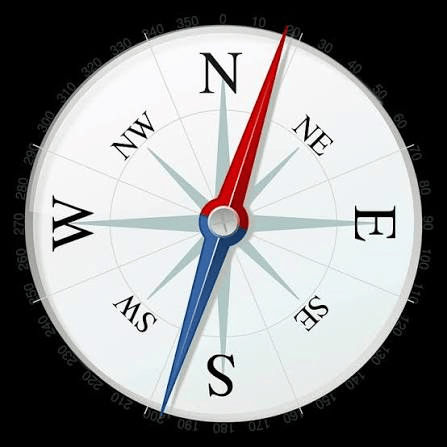
When you’re learning to navigate with a compass, you first establish a bearing. You know where you want to go, set your direction, and start walking. But you don’t simply put the compass away and assume you’ll stay on course.
Instead, you use the terrain around you. You walk toward a recognizable landmark, pause to check your direction, look up, and choose the next landmark. Then you continue. Along the way, you periodically check your compass and make whatever adjustment is necessary.
Why?
Because even when you begin in exactly the right direction, you can drift.
A tiny change in direction may not be noticeable at first, but the farther you travel, the more that small deviation can matter. A degree or two here and there may seem insignificant when you’re just getting started. After a long enough journey, however, you may find yourself somewhere very different from where you intended to be.
That’s true in the woods, and it’s true in life.
Small Deviations Add Up
Imagine that one of your legs takes a slightly longer stride than the other. The difference might be only half an inch, something you would never notice walking across a room. But if that small difference continues step after step, your body can gradually begin to turn. What started as an almost imperceptible difference can eventually produce a significant change in direction.
Life can work the same way.
Most people don’t suddenly decide to destroy their lives. More often, they drift off course through a series of small choices that, taken individually, may not seem particularly significant. It might be a relationship that gradually pulls them away from their values, an unhealthy habit they keep excusing, or simply another rationalization that says, “It’s not really that big of a deal.”
And maybe, in that moment, it isn’t.
The problem is what happens when that decision gets repeated. One compromise becomes another, and eventually those choices begin to establish a pattern. The pattern becomes a direction, and over time that direction can take us much farther from where we intended to be.
Direction matters.
The Danger of “Close Enough”
One of the most dangerous things about being off course is that you can be only slightly off and still feel like you’re doing fine.
If you’re one degree off, you may not notice it at all. You’re still moving. You’re still making progress. You’re still headed
somewhere.The problem is that somewhere may not be where you intended to go.That’s why I like the idea of a compass check.You don’t wait until you’re lost to check your direction. You check while you can still make a small correction.
What Is Your Compass?
When I work with people in counseling and coaching, we often end up talking about values. Not just what you want to accomplish, but what kind of person you want to be along the way. That’s an important distinction.
A goal tells you where you’re trying to go. Your values help you decide how you want to get there. Maybe you want to have a better marriage. That’s a good goal. But then you have to ask, “Are the way I’m talking to my spouse, the choices I’m making, and the way I’m handling conflict consistent with the kind of spouse I want to be?”
Maybe you want to get your finances under control. Are the decisions you’re making reflecting responsibility and integrity?Maybe you want to get healthier. Are the things you’re doing each day actually taking you in that direction?Maybe you want to grow spiritually. Are you making room in your life for that?
That’s where a compass check becomes useful. It’s not just asking, “Am I getting where I want to go?” It’s asking, “Is the way I’m living consistent with where I say I want to go?” And maybe even more importantly:”Am I becoming the person I say I want to become?” That’s a compass check.
Stop and Check
Sometimes we need to stop moving long enough to ask ourselves some honest questions. Where am I right now, and where have the choices I’ve been making actually been taking me? Is the direction I’m traveling consistent with the values I say are important to me? Is this particular decision moving me closer to the life I say I want, or is it gradually taking me farther away from it?
Those questions can be uncomfortable, but they are not meant to condemn us. They give us an opportunity to become aware of what is happening before the distance between where we are and where we want to be becomes even greater.
Being off course does not mean that you are a failure. It means that you have discovered something important about your direction. Once you recognize that, you have information you can use. You can reconsider your choices, make an adjustment, and begin moving in a better direction.
That’s what a compass is for. It doesn’t criticize you for being off course. It simply helps you recognize where you are and gives you the information you need to find your way again.
You Don’t Have to See the Whole Trail
One of the things I like about navigating in the woods is that you don’t always have to see the whole trail in front of you. Sometimes you can only see as far as the next landmark, and that’s okay.
You figure out your direction, pick a tree or some other landmark ahead of you, and start walking. When you get there, you pull out the compass, check your direction, and figure out where you’re going next.
Life can be a lot like that.
We can get overwhelmed thinking we have to know exactly where everything is headed. What will my life look like five years from now? Where will I be next year? How is all of this going to work out?
The truth is, sometimes we just don’t know. But we usually don’t have to know the entire route. We just need to know our direction and figure out what the next right step looks like.
Take that step. Get to the next landmark. Check your compass. Then figure out where you’re going from there. Sometimes that’s all you need to do.
Keep Your Eyes on the Path
Proverbs gives us a similar picture:
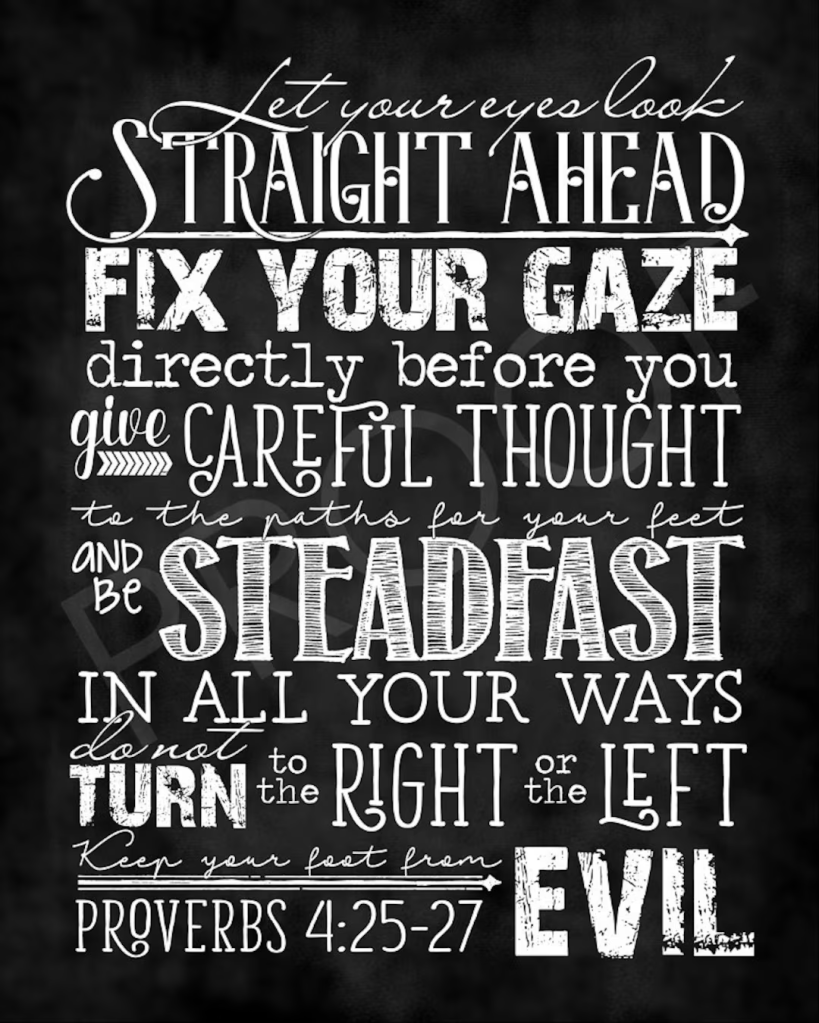
“Let your eyes look directly forward, and your gaze be straight before you. Ponder the path of your feet; then all your ways will be sure. Do not swerve to the right or to the left.”
Proverbs 4:25-27
There is something important about that combination.
Look forward. Consider your path. Don’t swerve.
The Christian life isn’t about blindly moving forward and hoping we end up in the right place.
It involves paying attention, pausing and examining our path,then recognizing when we’ve drifted and making corrections.
Your Values Can Help Point the Way
Values do not necessarily make our decisions easy. In fact, sometimes our most difficult decisions happen when two things we genuinely value seem to be pulling us in different directions. There are also times when doing what is consistent with our values comes with a cost, and the easier choice is to do something else.
What our values can give us, however, is a reference point for evaluating the choices we make. When we are uncertain about a decision, we can step back and ask ourselves whether what we are considering actually reflects the person we want to be and the kind of life we are trying to build.
Is this decision consistent with the values I say are important to me? Is it moving me toward the life I say I want, or is it gradually taking me in another direction? If I choose this path, will I be able to look back and recognize that my decision reflected the kind of person I want to become?
Sometimes those questions will confirm that we are headed in the right direction. Other times, they may reveal that we have started to drift. That does not mean we have failed or that we are hopelessly lost. It simply gives us an opportunity to stop, reconsider where we are headed, and make a course correction before we get farther off track.
That is what makes a compass useful. It is not there to tell you that you have failed whenever you get off course. It is there to help you recognize where you are and give you the information you need to decide what to do next.
The Goal Isn’t Perfect Navigation
There is something else worth remembering about navigating with a compass: good navigation does not mean that you will never get off course. That is simply not realistic. Even when we know where we are going and have a reliable bearing, we can get distracted, become tired, encounter an unexpected obstacle, or simply make a mistake. Sometimes circumstances change and the route we originally planned is no longer the best way forward. The same thing happens in life.
We make mistakes. We sometimes make decisions based on emotion rather than good judgment, and there are choices we look back on later and realize were not particularly wise. None of that means the journey is over or that we have permanently lost our way.
What matters is whether we are willing to check our direction and make an adjustment when we recognize that we have drifted. Someone who regularly checks their compass has a much better chance of catching a small deviation before it becomes a major problem.
I think that principle applies far beyond navigating a trail. We can use the same kind of check when we are evaluating a relationship, working through recovery, making an important life decision, or considering the direction of our spiritual lives. The question is not whether we have ever gotten off course. The more important question is whether we are willing to recognize it and do something about it.
In that sense, the compass is not really about perfection. It is about awareness, correction, and continuing the journey in the direction we intended to go.
So Check Your Compass

Maybe today is a good time to stop for a moment and take an honest look at the direction your life has been heading. That does not necessarily mean something is wrong, and it certainly does not mean that you have failed. Sometimes we simply need to pause long enough to make sure that the direction we are traveling still matches where we intended to go.
In the woods, that means pulling out the compass and checking the bearing. In life, it might mean taking a closer look at our values, our choices, our habits, and the patterns that have been developing over time. We can ask ourselves some fairly simple questions: Am I still headed toward the life I say I want? Are the choices I am making consistent with the person I want to become? Is the direction I am traveling actually consistent with what I say matters most to me?
If the answer is yes, then there is no need to overcomplicate things. Keep going.
If the answer is no, there is no reason to panic. Recognizing that you have drifted gives you an opportunity to make a correction. You can reconsider your direction, choose the next landmark, and begin moving that way. Then, somewhere down the trail, you can check the compass again.
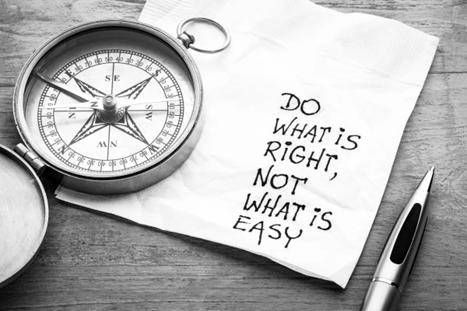
Maybe that is one of the most useful things I learned from orienteering. Finding your way is rarely about making one enormous decision that suddenly puts everything in order. More often, it is about paying attention to where you are going and being willing to make small corrections along the way.
Sometimes the wisest thing we can do is not to walk faster or try harder. Sometimes we simply need to stop for a moment, pull out the compass, and make sure we are still headed in the direction we intended to go.

