
Zacchaeus

I got to spend two entire summers living in Queretaro, Mexico. The first summer I stayed and worked at an orphanage, The second summer I lived and worked at the Bible house. This was when  I met  Mariano. He was a Guatemalan and lived in the bible house with me. Mariano was extremely outgoing, an ex stripper, and very funny.  Most of the time this was due to him constantly doing the unexpected. There are two main things I remember about him. The first was one of the nights it was my time to cook. I made just simple ham and egg omelets, which by the way purchasing eggs by the kilo is an interesting thing.

If you didn’t know, 1 kilo of eggs is about 20 eggs.  Anyway I digress, Mariano fell in love with omelets and this became his request every time It was my time to cook. The other thing I remember, was when we were both in  the States he had a wonderful panache  for inviting himself over for dinner. He would walk up to you at the end of church and say “ you need to take me to dinner “ or “ I’m coming to your house for dinner today.” 

He wouldn’t just do it to me, his old room mate, but would do it to my parents, the pastors, he never ever thought someone wouldn’t want him to come over.

The passage I am looking at today made me remember Mariano. Jesus invites himself to Zacchaeus’ house for dinner. 
Luke 19:1-10 

19 He entered Jericho and was passing through it. 2 A man was there named Zacchaeus; he was a chief tax collector and was rich. 3 He was trying to see who Jesus was, but on account of the crowd he could not, because he was short in stature. 4 So he ran ahead and climbed a sycamore tree to see him, because he was going to pass that way. 5 When Jesus came to the place, he looked up and said to him, “Zacchaeus, hurry and come down, for I must stay at your house today.” 6 So he hurried down and was happy to welcome him. 7 All who saw it began to grumble and said, “He has gone to be the guest of one who is a sinner.” 8 Zacchaeus stood there and said to the Lord, “Look, half of my possessions, Lord, I will give to the poor, and if I have defrauded anyone of anything, I will pay back four times as much.” 9 Then Jesus said to him, “Today salvation has come to this house, because he, too, is a son of Abraham. 10 For the Son of Man came to seek out and to save the lost.”

I can imagine the thoughts going through Zacchaeus mind Much like when Mariano would invite himself over.. what am I going to make, do I have enough, have I even  made anything.

Is the house clean? Whether Zacchaeus had any of these thoughts  we don’t know, but we do see his excitement.

Now I know you have to all be familiar with this story, even if from nothing more than the song. Most of us who grew up in church know this little song, and any mention of Zacchaeus starts playing in our brains. Zacchaeus was a wee little man and a  wee little man was he…

The story of Zacchaeus climbing a tree is fun to share with young children; especially because they are also ‘wee little’ people. Yet there is so much to learn about him beyond the fact that he was a short guy who hung out in trees.

However, I want to take a different approach to this story. Zacchaeus was a tax collector .They were not well liked. I will go more into tax collectors in another writing, but suffice it to say they were hated as many were not fair in their dealings.  However, I want to focus on this particular verse: 

“Zacchaeus stood there and said to the Lord, “Look, half of my possessions, Lord, I will give to the poor, and if I have defrauded anyone of anything, I will pay back four times as much.”

Is Zacchaeus’ declaration of his financial dealings in verse 8 a promise of future action in response to Jesus’ visit, or is it a report on his present behavior? Grammatically speaking Are the present tense verbs in verse 8 to be understood, in fact, as present tense, thereby describing the current and ongoing behavior of Zacchaeus (as in the RSV and KJV )? Or shall we give them a future cast, describing Zacchaeus’ penitent pledge of future behavior (as in the NRSV and NIV)?Scholars, as well as translators, are divided, because it is correct to translate it as I will give or I give.”

1 If the former, then this is a classic repentance story; if the latter, it is something else entirely. Most of us have heard the general repentance story that preaches so easily from this story…

It has a nice flow of action — Jesus honors Zacchaeus, which prompts his changed behavior, which Jesus then acknowledges — it also plays well with the theology most of us hold: repentance precedes forgiveness. It is therefore easy to conclude — and preach — that in the presence of Jesus all manner of unimagined things can happen, even a wealthy tax collector might give away half his wealth. Or we might deduce — and proclaim — that our repentance must include matters of the wallet as well as the heart, that makes a great sermon on giving. Yet let’s take a look at the entire context of Luke, he has already shown that Jesus has an affect on the sinful tax collector like ole Levi, who later goes by Matthew.

 So a synopsis of what we read here:

Jesus, near the end of his journey to Jerusalem, is passing through the border town of Jericho. In that town is a man named Zacchaeus who is not just a tax collector but a chief tax collector which means, as Luke’s Gospel explains, that he is rich. He wants to see Jesus, but because he is short he cannot see over the crowds, so he climbs a tree. When Jesus arrives at the place where Zacchaeus has perched himself, he calls him down and invites himself to Zacchaeus’ home, which simultaneously brings Zacchaeus joy and scandalizes the crowd, because they know that Zacchaeus is a sinner.

This story is only told by Luke, and there are  several details that stand out, particularly in relation to passages that have come just before this one. First, sight is important.  Earlier, in Luke’s story of the lepers, it is the tenth leper’s recognition that he has been healed that causes him to alter his course, when he saw that he was healed (17:15). In the passage immediately before what we have read today a blind man receives sight and, in response, follows Jesus and glorifies God. Now, Zacchaeus desires to see Jesus, but even as he is trying to catch a glimpse of this prophet Jesus looks up, calls him down, and honors him by coming to dinner and staying at his home.

A second significant detail is wealth. Luke, more than any other gospel writer, is consistently concerned about matters of wealth and treatment of the poor. In the previous chapter a rich man, when asked to give away all he had, departs Jesus in sadness. When Jesus declares that it is nearly impossible for the rich to enter the kingdom of God, the disciples — who like most of their time believe wealth is a sign of God’s favor — are shocked. In contrast, in this story another rich man receives Jesus with joy and gives (or promises to give) half of his wealth to the poor and restores (or promises to restore) fourfold any amount he may have defrauded, and Jesus announces that the impossible has now happened as “salvation has come to this house” (19:9).

Zacchaeus is short, not just in physical stature, but also in terms of his moral standing among his neighbors who, no doubt, despised him; hence their reaction when Jesus invites himself to Zacchaeus’ home. This is not the first time bystanders have been outraged by Jesus’ behavior. Think of Simon’s reaction that Jesus would allow a woman all seem to know has a poor reputation to wash his feet with her tears (7:39) or the reaction of the Pharisees to the sinners and tax collectors who love to listen to Jesus (15:1-2). Nor is this the first time tax collectors have figured prominently in Jesus’ ministry. it is  their delight in Jesus’ teaching that prompts the grumbling that in turn Jesus’ “lost” parables. And chapter 17:14 it is the penitent tax collector, not the righteous Pharisee, who returns home justified.

What is Luke’s overall point, is he just repeating the same old tune?

 Notice that Zacchaeus neither confesses his sin nor repents. Admittedly, one can view Zacchaeus’ pledge of future behavior as repentance, but it remains a view point and contrasts starkly with the previous verbal penitence, for instance, of the tax collector at the Temple (18:13). Nor does Jesus commend Zacchaeus’ penitence, or his faith, or his change of heart. He merely pronounces blessing, blessing based not on anything Zacchaeus has done but simply because he, like those grumbling around him, is an Israelite, a son of Abraham. Further, Zacchaeus does not offer his financial disclosure in response to anything Jesus has said; rather, it falls on the heels of the grumbling of the crowd. Perhaps it is a response to Jesus’ presence, but perhaps it is his bewilderment at the crowd’s complaint or a defense of his reputation. In either case, I suspect that Zacchaeus is not turning over a new leaf as much as he is lifting up an old one for all to see. which also matches correct interpretation :

The amplified reads Zacchaeus stopped and said to the Lord, “See, Lord, I am [now] giving half of my possessions to the poor, and if I have cheated anyone out of anything, I give back four times as much.”

What if instead of another tax collector repenting this is a story  in which Jesus does the unexpected. Like somebody inviting themselves to dinner.

Called By NameNotice that Jesus calls this chief tax collector by name. “Zacchaeus, come down; for I must stay at your house today.” There is both intentionality and urgency in Jesus’ summons. From the outset of Luke’s gospel and throughout its narrative, Jesus sides with those on the margin, those considered down and out, those not accounted as much in the eyes of the world. While Zacchaeus is rich, he is nevertheless despised by his neighbors, counted as nothing, even as worse than nothing. Yet Jesus singles him out. Why? Might he know of Zacchaeus’ exemplary behavior? We cannot know. Yet by seeing him, calling him, staying with him, and blessing him, Jesus declares for all to hear that this one, even this chief tax collector, is a child of Abraham…and child of God. Perhaps Jesus is again at work seeking out those who are lost (whether through their own actions or those around them) in order to find, save, and restore them.

Or perhaps Zacchaeus serves as yet further evidence of the manifold possibilities present in Jesus’ presence. Thus far, almost everything about this story seems impossible — that a chief tax collector would want to see Jesus; that Jesus would stay in his home; that it would be revealed that this sinner exceeded the law by his generosity; that Jesus would declare not just him but his whole household saved? Yet just earlier Jesus declared that what is impossible for mortals is nevertheless possible for God (18:27). It would make sense for Luke to then show Jesus doing exactly what he said?

Perhaps Zacchaeus is one more example of the impossible possibility that Jesus embodies and regularly manifests.

Or perhaps Zacchaeus simply represents the chief attribute of all disciples: a desire to see Jesus and a corresponding joy in his presence. Zacchaeus cannot see Jesus because he is too short and so the crowds impede his sight. Yet this rich chief tax collector is so desperate to see that he will not be deterred and humiliates himself by climbing a tree like a child in order to glimpse over the crowd and see Jesus. Much like the woman with the issue of blood not being deterred but pushing through the crowd in Luke 8. Read this way, this story is not about formulas regarding repentance and forgiveness — indeed, as in other places in Luke, it calls into question any attempts to reduce the miracle of salvation to a formula like his being anointed by the “sinful woman” Luke 7  Rather, it embodies the promise that anyone — anyone! — who desires to see Jesus will. More than that, anyone who desires to see Jesus will, in turn, be seen by Jesus and in this way have their joy made complete. Imagine, you want to see Jesus, and instead of just seeing him, you have dinner with Him?

WOW. ANYONE can hang out with  Jesus. If we want to see Jesus, we can, but more than that, He WILL see us. He knows us, and will call us by name.

Maybe we should ask who among us, both in our congregation and outside, are those who have been left on the margin, who have been ruled out of bounds, who might surprise us by their generosity and faith, and who just want to see Jesus but have been kept at bay. If we are willing to ask — and dare answer — such questions, we might see both Zacchaeus and Jesus in a whole new light that changes us just as much as having dinner with Jesus would change people in the Bible.

Sauce Piquant

Sauce Piquant , with its silent q and nasal “a”  sound is pronounced pee-kuhnt. Its literal meaning is spicy sauce in French. Its original origins are hard to pin down, but the Cajun and Creole variant traces its roots to French and Haitian cuisine. 

When describing this rich flavorful sauce, imagine a rich red hue that is bursting with the flavors of tomatoes accented with the underplay of a bold and nutty flavor. Then, keeping with its name there is a bit of kick that accompanies this dance of savory and spice across your taste buds. 

This sauce is very similar to the Mother sauces utilized in classic French Cuisine. In other words, this is a sauce that can be paired with many things to create a meal. The meat used with this sauce ranges from chicken and seafood to turtle, rabbit, gator, or pretty much anything you can get your hands on.  It can be used as a dip for nice toasted crisp baguettes or more traditionally served over rice. 

As with many Cajun and Creole dishes, there are about as many different recipes as there are Mamas, Papas, and Grandma-mas out there making the dish, each claiming theirs is authentic and the best. They are probably all correct. 

One thing remains the same across the board, It’s spicy. Even though Spicy does not always mean heat,  for example Creole sauce is flavorful with spice  but not necessarily Hot Spicy, Sauce Piquant is supposed to live up to its name.

Chef Paul Prudhomme says “if you don’t hover between pleasure and pain when you eat it, chances are you haven’t made your sauce piquant hot enough!”

I have also heard of recipes that do not use a roux in their sauce piquant. Maybe I’m stuck in my ways, but the beginning of every Cajun or Creole recipe is found in the phrase, “first you make a roux.” 

So on to the recipe. 

Heat a pot or large skillet over low heat. a cast Iron Dutch oven, or if you are lucky enough to have a Magnolite pot, by all means use that. When the pot or skillet is warm add your butter/oil/or grease (it’s OR not and). Butter is more in line with Creole style, the oil/or grease is generally more of the historical Cajun style. Check my earlier post, Cajun vs Creole, for more in depth explanation on the differences.

When the oil is warm add the flour. Now my wife has Celiac Disease. This is an autoimmune disease, but it is easiest described as a severe gluten allergy. She can’t have anything made with wheat, flour, etc. Ergo I have experimented with various gluten free flour alternatives. There is a gluten free flour mix that works well and almond flour makes a good roux adding to the complex nutty flavor that is naturally developed when making a roux. That is the only two I personally would recommend for making a roux if you need a gluten free alternative.

That being said, making a good roux is a labor of love, it is not a super quick endeavor, but the difference in flavor is phenomenal. Cook until the mixture begins to darken. Various different colors of roux are used for different dishes. Keep stirring and be sure not to burn it. Black flecks and burnt smell indicate you need to try again. Just be patient and keep stirring. For Sauce Piquant, i se a lighter color roux. similar to peanut butter color that gives off a nice nutty aroma. My gumbo will use a much darker roux. It can take up to 45 minutes. Be careful, you will be tempted to raise the temp, but this increases the likelihood of burning if you are not careful. When the roux is ready, remove from heat and set to the side. 

You will want to sauté your Holy Trinity, that is your onion, bell pepper, and celery with the Pope (garlic) lol. Deglaze the pot you were just using with a little water or stock while sautéing the Trinity (onions, bell pepper, celery).  Those begin to get soft, add the garlic (the Pope lol)  and jalapeno then sauté another minute. Add the various seasonings and sauté another minute. Add the stock, tomatoes, Tomato paste, and Worcestershire sauce. Raise to medium and stir while bringing to a light boil. Reincorporate the roux in slowly, stirring to mix.. Reduce the heat to low and simmer for 20-30 minutes, stirring occasionally, until the sauce has thickened to your desired consistency. you can add your favorite hot sauce at this time, or save for

each individual to add per their own desire. I personally do both. It is Sauce Piquant after all. My favorite with this is Louisiana or Texas Pete. Tabasco also works, especially the Chipotle which adds a bit more of a smoke flavor. I used some Louisiana and some Gator Drool by Stale Cracker this time around.

Adjust seasoning to your taste. Prep whichever protein you are using accordingly during this time and add to the sauce when it has reached the desired thickness. Most game and chicken can be lightly floured and browned if desired. I actually like grilled chicken with this and I have also used leftover fried chicken with the sauce before. Crawfish and shrimp I just dust in some Cajun seasoning and throw it in. Crabmeat, NOT IMITATION, pairs well with crawfish in this sauce. Serve over rice or use it as a dip for your favorite bread. I have also seen it used as a sauce over potatoes, personally not my thing.

This time when I cooked it , it was a bit of a hodge podge with what we had. I threw a few sausages and some chicken tenders on the grill. I also sautéed some shrimp in butter and white wine.

It really turned out good , even if I do say so myself. Give it a try sometime and tell me what you think. If you grew up with Cajun influence, let me know did your family have a Sauce Piquant recipe, if so how did it differ?

Ingredients:

  • 3 tablespoons butter, oil, or bacon grease
  • 3 tablespoons all-purpose flour ( can substitute a gluten free version)
  • 1 small onion, finely chopped
  • 1 green bell pepper, finely chopped
  • 2 celery ribs, finely chopped
  • 3 garlic cloves, minced
  • 1 can crushed tomatoes (14 ounces)
  • 1 tablespoon Tomato paste
  • 1 cup chicken, seafood, or vegetable broth
  • 1 teaspoon paprika
  • ½ teaspoon crushed red peppers
  • 1 teaspoon Cajun/ Creole Seasoning of Choice (I prefer low sodium)
  • 1 teaspoon cayenne pepper
  • 1 Jalapeno Chile Minced (may be omitted if afraid of too spicy)
  • 1 teaspoon thyme
  • 2 bay leaves
  • 1 Tablespoon Worcestershire sauce
  • Favorite Hot Sauce to taste 
  • Salt and black pepper, to taste
  • If your meat is seafood, add juice of half a lemon
  • ¼ cup cut fresh parsley (for garnish)
  • 1 chopped green onion (optional garnish). 

ENJOY!!!!

 Don’t Live for the Likes. 


Love it or hate it, Social Media is a huge part of society. With apps like Facebook, Instagram, Twitter, SnapChat, YouTube, WhatsApp, TikTok, WeChat, Pinterest, Linkedin, and a host of others, there is something for everyone. You can even make a decent educated guess regarding someone’s age group based on the social media they use the most. It is a great way to stay connected, network, and just have fun, however it can also lead to drama and cause people to have a tendency to live for the likes. What I mean by this is to be worried about how many followers, what people think about them, are people liking their posts, how much interaction are they getting, it can be overwhelming. We all have a tendency to want to be liked to some degree or another, after all We are created as social beings and we really can’t do life alone, even the Lone Ranger had Tonto.  Now though scripture does not mention social media, it does have some things that are applicable to this topic. 

Take a look at  Matthew 23:1-12

“Then Jesus said to the crowds and to his disciples, “The scribes and the Pharisees sit on Moses’ seat; therefore, do whatever they teach you and follow it; but do not do as they do, for they do not practice what they teach. They tie up heavy burdens, hard to bear, and lay them on the shoulders of others; but they themselves are unwilling to lift a finger to move them. They do all their deeds to be seen by others; for they make their phylacteries broad and their fringes long. They love to have the place of honor at banquets and the best seats in the synagogues, and to be greeted with respect in the marketplaces, and to have people call them rabbi. But you are not to be called rabbi, for you have one teacher, and you are all students. And call no one your father on earth, for you have one Father—the one in heaven. Nor are you to be called instructors, for you have one instructor, the Messiah. The greatest among you will be your servant. All who exalt themselves will be humbled, and all who humble themselves will be exalted.”

]

Believe it or not, October is just around the corner. This means Halloween and  All saints Day is just around the corner.  I find this scripture selection ironic considering the way society celebrates  Halloween, where people dress up, pretend to be people and things they are not, wearing  masks etc because this

scripture is about the hypocrisy of the religious leaders of Israel. Their dress, their deportment, their teaching, their demand for salutations that curry honor from the people, and even their very presence is a magnificent pretense, offensive to God and painfully imprisoning for those who follow them.

Are we who we portray ourselves to be? And does it matter?

In Hamlet: The Tragedy of the Prince of Denmark, Polonius, the chief counsel to the murderous King Claudius, tells us his son, Laertes:

“This above all: to thine own self be true, And it must follow, as the night the day, Thou canst not then be false to any man.”[1]

“To thine own self be true,” is a rebuke to Laertes who is in a disastrous contest for Ophelia. 

Many 12 step programs as they work with people to break the cycle of addiction use this as a reminder , To thine own self be true.

I often have issues with this, Yes we need to be true to ourselves and not fall into the Rat Race of impressing others, doing things for the sake of how it looks, but scripturally, there isn’t much in of ourselves that is good to be true to  outside of Christ and so it needs a caveat, to thine own self in Christ be true. 

We generally know ourselves according to the manner in which we  think of ourselves. Others usually see us differently. If we are completely honest, we do not always view our own selves correctly. I find myself looking in the mirror and not always recognizing who looks back as changes happen through the years. 

One of the goals of personal and spiritual growth is to know who we are, as we are, as we are known, as God desires us to be, and to make sure there is truth in what is shown.You know me as a pastor. In a sense, I have worked to have you to know me as such. I have been working on an education and being credentialed for this role. Is it for self or for God? And with such a role comes expectations.

Perhaps, you say to yourself when you see me, “If he is a pastor he must hold to all those characteristics that Paul speaks of in 1 Timothy 3.” Beyond Biblical expectations, there are social or we might say “cultural” expectations. He is faithful to His Word, His wife, His family, and he is devoted to God. 

Or, does  your own cultural experience lead you to think  Christian minister equals a fraud. , an Elmer Gantry.   Elmer Gantry is a movie from the 60’s starring Burt Lancaster and Shirley Jones. However, Sinclair Lewis published the novel Elmer Gantry in 1927 at the height of the roaring twenties and Prohibition (the Volstead Act creating the 18th Amendment of the U.S. Constitution, 28 October 1919), Both the law and Sinclair was influenced by the moral zeal of Midwestern evangelicals. So, Lewis left his native northeastern suburbs for Kansas City. He went to church. He watched preachers. The Methodist Episcopal Church South was the largest denomination in the land and very prominent in Kansas City. So, the famous and sometimes infamous author crafted a character based not upon his observations of ministers in Kansas City, but upon his own prejudice against evangelical Christianity. His disdain for pastors is undeniable as you read the last lines of Elmer Gantry. Having been sued for $50,000 by an angry husband of a woman under the spell of Gantry, and with his association with distillers made known, Lewis ends with this scene:

“Oh, my friends!” cried Elmer, “do you believe in my innocence, in the fiendishness of my accusers? Reassure me with a hallelujah!” The church thundered with the triumphant hallelujah, and in a sacred silence Elmer prayed “O Lord, thou hast stooped from thy mighty throne and rescued thy servant from the assault of the mercenaries of Satan! Mostly we thank thee because thus we can go on doing thy work, and thine alone! Not less but more zealously shall we seek utter purity and the prayer-life, and rejoice in freedom from all temptations! He turned to include the choir, and for the first time he saw that there was a new singer, a girl with charming ankles and lively eyes, with whom he would certainly have to become well acquainted. But the thought was so swift that it did not interrupt the oæan of his prayer “Let me count this day, Lord, as the beginning of a new and more vigorous life, as the beginning of a crusade for complete morality and the domination of the Christian church through all the land. Dear Lord, thy work is but begun! We shall yet make these United States a moral nation!”[2]

So, is the truth of Elmer Gantry that the character is flawed, evangelical Christianity is a sham? Or could it not be that the author is flawed?

Yet, what about you? How does the public person and the private person that you are  compare to each other.? Do they? And why does it matter?

 Well mainly because It matters to God. The Lord has condemned It. Jesus called the Leaders of his day out of it frequently. Pointing out their Hypocrisy. In our scripture today he says to listen to them, but don’t do as they do. Sinclair Lewis’ Gantry has nothing on these guys. . And how the world has changed since SInclairs days. 

Parents often catch themselves saying things like, “Do as I say not as I do”, however plenty of studies show that the example watched often holds more power than the words, therefore it is important to work toward walking out what you say. 

And so hypocrisy continues, it is part of the fallen human condition. We want people to see us in a good light, often to think of us better than we think of ourselves. 

To seek the approval of others has always been a struggle for humanity, and in Today’s society the Rat Race pushes many to seek approval of others in ways previous generations could not have even imagined. 

In our algorithmically driven age, everything is done for attention. Nothing is safe. Whether it’s posting a picture of your food or sharing a video detailing your morning grooming routine, or documenting every detail of your best, worst, or most mundane moment, all of human life exists for display. People post pictures hoping to get others to like them. I do it, it is an easy way to share and keep up with friends and family, but we need to be mindful of the driving force beyond why we do it. 

 This isn’t new to our species – merely amplified by technology. God has a different, simpler, and humbler plan.  

It isn’t that he never wants us to be exalted, to get atta boys, but get them for the right reasons and most importantly the right way. See we are not to Lord things over others, and do you know why? Because we are all equal in God’s eyes. Yes equal in worth, equal in the love he has for us, but also equally screwed up. Equally in need of a savior, equally separated from Him outside of His son Jesus. There is none good, no not one. And so in my opinion a better phrase to remember beside to thine own self be true is except for the grace of God there go I. Anytime we look at someone and think How we are better off, remember it has nothing to do with ourselves and everything to do with the Grace and Love of God.

The greatest among you will be your servant. All who exalt themselves will be humbled, and all who humble themselves will be exalted.  God wants us to allow Him to exalt us, let His work in us and through us be what brings glory, praise, exaltation. Since he is the only one worthy of all praise, it is the appropriate way. Being liked is a good thing, but let’s get likes because we share Jesus in our lives to others and not get our view of our self worth from the status of our social media. You are loved by the creator, you already have worth, regardless of the likes your posts get. Never forget that!

Let Go of Your Comfort Zone

In 1 Corinthians 9:16-23, Paul writes, “If I proclaim the gospel, this gives me no ground for boasting, for an obligation is laid on me, and woe to me if I do not proclaim the gospel! For if I do this of my own will, I have a reward; but if not of my own will, I am entrusted with a commission. What then is my reward? Just this: that in my proclamation I may make the gospel free of charge, so as not to make full use of my rights in the gospel. For though I am free with respect to all, I have made myself a slave to all, so that I might win more of them. To the Jews I became as a Jew, in order to win Jews. To those under the law I became as one under the law (though I myself am not under the law) so that I might win those under the law. To those outside the law I became as one outside the law (though I am not free from God’s law but am under Christ’s law) so that I might win those outside the law. To the weak I became weak, so that I might win the weak. I have become all things to all people, that I might by all means save some. I do it all for the sake of the gospel, so that I may share in its blessings.”

Ministry carries Paul all over the place. For a middle class kid from Tarsus, he experiences a broad swath of life on behalf of God. He transforms himself into all things for all people in order to reach as many folks as possible. Following Jesus sometimes means letting go of our comfortable bubbles and putting ourselves where God needs us.  I want you to ask yourself: What is your passion, what drives you, are you compelled in your Christian mission?
 Paul in his Second Letter to the Corinthians chapter 5, declares, “For Christ’s love compels us, because we are convinced that one died for all and therefore all died.  And He died for all, that those who live should no longer live for themselves, but for Him who died for them and was raised again.”  The love of Jesus compels us.”

As it relates to this text, what is it in our relationship with Jesus Christ that will not let us rest? Paul is saying that our love for Jesus , the understanding of what He did for us individually should excite us, even drive us to do things to demonstrate our love for Jesus, not to try and earn what we already have. So what is it that we are passionate about? I keep asking this because oftentimes these areas , where our passions lie, are opportunities for ministry that we might not be aware of. Ministry isn’t just standing in a pulpit, or going door to door. Not everyone is called to be on the street corner witnessing. Besides, in today’s culture this isn’t the most effective way to reach people anyway. 

One of the interesting testimonies of Dr.Martin Luther King Jr.  was that upon his graduation from Crozier Theological Seminary in Pennsylvania, and his PHD at Boston University, his goal was to serve as a teaching professor in academia in one of the nation’s highly revered Seminaries.  A career that might be somewhat removed in relative seclusion and isolation from the realities of those suffering under the sweltering heat of an oppressive inequality,away from the  racial and social injustice in a majority of urban America cities of the deep south.

But the Spirit of the Lord was upon King, it seized Martin’s very soul, it would not let him rest until he answered the call to return to the Deep South and stand in solidarity with those ready and waiting for leadership to guide them in addressing the need for social as well as some soul transformation in our nation.

Jesus’ journey to Calvary during his final week and hours is called the Passion of the Christ, because it would not let him go, until He had fulfilled His mission here on planet earth in giving His life in order to buy our souls back for Satan, sin, hell, death and the grave.  He once said on His way to Calvary, “I must work the works of Him who sent me while it is day, for the night comes when no one can work”  (John 9:4).

Because He was passionate about dying for us, in our place, God moved Charles Wesley to write that memorable tune, O For A Thousand Tongues To Sing which reminds us “He breaks the power of canceled sin, He sets the prisoner free; His blood can make the foulest clean; His blood availed for me.”  Jesus was passionate in His mission to save us from ourselves.

So do you love Jesus enough to step out of your comfort zone? Are you willing to take a look at the areas you are passionate about and see how it could be used to bring glory to God? If you are not passionate about anything, are you willing to ask God to give you a passion? It’s time for us all to move outside of our God Box and serve in different ways than we ever imagined. 

What Kind of Soil am I ?

sower

Matthew 13: 1-9; 18-23

13 On that day Jesus went out of the house and was sitting by the sea. Such large crowds gathered around Him that He got into a boat and sat down, while the whole crowd stood on the shore.

Then He told them many things in parables, saying: “Consider the sower who went out to sow. As he was sowing, some seed fell along the path, and the birds came and ate them up. Others fell on rocky ground, where there wasn’t much soil, and they sprang up quickly since the soil wasn’t deep. But when the sun came up they were scorched, and since they had no root, they withered. Others fell among thorns, and the thorns came up and choked them. Still others fell on good ground and produced a crop: some 100, some 60, and some 30 times what was sown. Anyone who has ears should listen!”

“You, then, listen to the parable of the sower: 19 When anyone hears the word about the kingdom and doesn’t understand it, the evil one comes and snatches away what was sown in his heart. This is the one sown along the path. 20 And the one sown on rocky ground—this is one who hears the word and immediately receives it with joy. 21 Yet he has no root in himself, but is short-lived. When pressure or persecution comes because of the word, immediately he stumbles. 22 Now the one sown among the thorns—this is one who hears the word, but the worries of this age and the seduction of wealth choke the word, and it becomes unfruitful.23 But the one sown on the good ground—this is one who hears and understands the word, who does bear fruit and yields: some 100, some 60, some 30 times what was sown.”

This is an excellent example of one of the ways Jesus would teach, with parables. This is a “true Parable” meaning it is told to illustrate only one point and draws from the daily observations of everyday life. In this case it relates to farming, something that would have really been appropriate to the audience he was addressing and can be related to many of us here. I don’t know how many of you are gardeners, I sort of fiddle with it and I have had varied success and failures with gardens over the years.

biloxi map

I grew up in Biloxi, Ms. This is a coastal town and I grew up surrounded by water. The Tchoutacabouffa River

 was a mile behind my house. Biloxi Bay was 5 miles away and it was just a short way past that and you hit the Gulf of Mexico. Growing up I learned a certain to make gardens. So when I first moved to East Texas and tried a garden, I did it the way I learned. I made my mounds about 6 inches high, busted the top of them, and planted the seed and so forth. Nothing worked out right. The corn only grew to about 2 feet tall and other issues. A friend came by and looked at the garden and asked why I made my mounds that way. I quickly explained you had to do that so that all the rain and standing water after the rain doesn’t wash your seeds away. See Biloxi’s average Annual rainfall is 65 inches a year. July is the wettest month with usually averaging over 7 inches just in July…well needless to say I had not taken into consideration the new climate and difference in the soil.  Good gardeners understand for seeds to truly grow, you need the right soil.

soil

This parable is often known as the parable of the sower and the seed, which is really the heart of the message, however I want to look at the soil first. All four types of soil are essentially the same dirt but are in different conditions and respond in different ways to cultivation.

What made one soil more responsive and the other less?

sowing

In Biblical times, communities were mainly agriculturally based. The farming methods however were different in those days. They actually sowed the seeds first then plowed them under as opposed to the technical way in which we have of plowing first, making rows and planting each seed to a certain depth depending upon the type of seed.


pathA family would be appointed a section of land to farm. Each farmer’s plot was adjacent to his neighbor’s. In order to get to the fields, they walked along the boundaries bordering each field to avoid stepping on the growing plants. The “path” was held in common by all the farmers. Over time, the soil on the path would compact. It was never plowed and never fertilized. In the parable, the seed that is sown on the path is not able to penetrate the ground because of the constant use. The condition of the first soil is hard and impermeable.

rocky soil


The second type of soil mentioned in the parable is the “rocky” places” or the shallow soil where the plow didn’t cut deeply enough to break up the shale or hard ground just below the surface. This soil produced only plants with weak, shallow roots.


thorns-1053424_960_720.jpg


The third type of soil mentioned is the thorny soil, most likely found in the corners of the field where the plow couldn’t reach; here, weeds overtook what was planted.

All the types of soils mentioned here are actually in the same plot of ground with one major difference: Only one area was fully yielded to cultivation, to being changed and prepared for planting. That area was called the good soil.

In the explanation, the soil along the path represents those who never really hear the word with understanding. The Word of God must be understood before it can truly bear fruit. One of the enemy’s chief works is to keep men in darkness regarding their understanding of the word.

the-four-soils-600x400

The rocky ground soil represents those who receive the word enthusiastically but it is short lived. They do not endure because the word has not been allowed to go deep and make strong roots. 

Charles Spurgeon made a good point in stating, “the fault did not lie in the suddenness of their supposed conversion, many sudden conversions have been among the best that have ever happened” So the problem was not the growth but their lack of depth. Without deep roots, they were not able to stand against the storms of life.

The soil that landed among the thorns showed growth, but allowed other things to grow along side and ultimately was choked out for the competition of other things. 

harvest.jpg

The good soil was those who received the word, let it grow roots, and it bore fruit on differing portions, some 100, some 60, and some 30. 

This would be a good place to pause and ask, what kind of soil am I? This is actually the title of the sermon, but this is really a bit of a trick question. To be honest none of us are just one type of soil, 

Like the path sometimes we allow the Word no room at all in our lives

Like the rocky places, we sometimes have flashes of enthusiasm that quickly burns out

Like the thorny area we sometimes get overwhelmed and bombarded by the other things we allow in our life. The cares of this world and the deceitfulness of riches are allowed to grow and block out the true priority and therefore choke out God’s Word and prevent its fruitfulness in our life.

And then there are times, like the good ground, the Word bears fruit in our lives.

Each of us has all four kinds of soil in our hearts, but despite all the talk about soils, despite the importance of knowing how we allow our hearts to respond, the Parable of the Sower isn’t really about dirt at all. The Parable of the Sower is, as the name implies, really about the Sower.

ParableTeller

Remember I said parables illustrate one main point? In this parable, nowhere does Jesus go and say we need to be good soil. In fact Jesus says to consider the sower and then focuses on the return of the harvest in spite of where the seed lands.

As important as it is for us to be aware of what’s going on in the soil, This story is a description of our loving God. God knows it is foolish to spread seed on unworthy soil, but he does it anyway. God spreads his love with reckless abandon in hearts that are at once all four different types of soil. We see this as Jesus throws seed at the disciples who over and over and over again prove that they have hard hearts, stiff necks, and dim minds. Jesus continues to throw seed at them, continues to work with them, and continues to help them see what God is up to in the world around them. He scatters the seed of the Gospel with wild recklessness, and even when it is clear that his disciples just don’t get it, when they turn him over to the authorities, abandon him in his hour of need, and deny even knowing him; Jesus continues to pour out his love on them by inviting them back into the fold after the resurrection. Throughout His earthly ministry Jesus continued to throw the seed, even to the Pharisee’s and though some never changed their heart, there were many who did because he continued to love recklessly.

gods embraceGod is downright foolish in his love for you and me as well. We who continue in the proud hard hearted, stiff necked and dim minded tradition of the disciples. We who neglect to build the kingdom and instead focus on building ourselves. We who show again and again why we need forgiveness and we forget again and again to give it to others. The good news is: God continues to throw seed at us. He pours out his love upon us relentlessly. And when he finds even the smallest patch of good soil in our hearts, he nurtures the Kingdom within us, producing an abundant harvest: 30, 60, even 100 fold if we will just give him the opportunity. This parable is about God and his wildly extravagant love for us, and that, my friends is more than enough when we allow him to work in whatever kind of soil is in our hearts.

 There is a song by Corey Asbury called Reckless Love , You should listen to it and realize its about His love and you.  I have included the lyrics: Reckless Love by Cory Asbury

Reckless Love

Before I spoke a word, You were singing over me
You have been so, so good to me
Before I took a breath, You breathed Your life in me
You have been so, so kind to me

Oh, the overwhelming, never-ending, reckless love of God
Oh, it chases me down, fights ’til I’m found, leaves the ninety-nine
I couldn’t earn it, and I don’t deserve it, still, You give Yourself away
Oh, the overwhelming, never-ending, reckless love of God, yeah

When I was Your foe, still Your love fought for me
You have been so, so good to me
When I felt no worth, You paid it all for me
You have been so, so kind to me

And oh, the overwhelming, never-ending, reckless love of God
Oh, it chases me down, fights ’til I’m found, leaves the ninety-nine
And I couldn’t earn it, and I don’t deserve it, still, You give Yourself away
Oh, the overwhelming, never-ending, reckless love of God.

There’s no shadow You won’t light up
Mountain You won’t climb up
Coming after me
There’s no wall You won’t kick down
Lie You won’t tear down
Coming after me

Oh, the overwhelming, never-ending, reckless love of God
Oh, it chases me down, fights ’til I’m found, leaves the ninety-nine
And I couldn’t earn it, I don’t deserve it, still, You give Yourself away
Oh, the overwhelming, never-ending, reckless love of God, yeah


My friends how will you respond to the overwhelming, never-ending, reckless love of God in your life this week? Will you let it be trampled and stolen? Will it get choked out? Or will you let it grow and form deep roots in your heart? 

God’s Promises

The loud sound of the gavel striking its wooden sound block echoed through the courtroom. The pain, rejection, feelings of failure, brokenness, and confusion that come from divorce would echo through my mind for years. Life does not always take the path that we expect. Years before that failed marriage even started I spent two entire summers in Queretaro, Mexico. One was spent working in an orphanage and the other was spent living in a Bible school while helping build a church in neighboring San Miguel De Allende. These trips were just one of many instances that God used to place a promise in my heart. A promise that was often obscured from my view by life’s many twists and turns. Promise is at the heart of this post.

Galatians

  • Scripture: Galatians 3:23–29    
  •  23 Before this faith came, we were confined under the law, imprisoned until the coming faith was revealed. 24 The law, then, was our guardian until Christ, so that we could be justified by faith. 25 But since that faith has come, we are no longer under a guardian, 26 for you are all sons of God through faith in Christ Jesus.

27 For as many of you as have been baptized into Christ have put on Christ like a garment. 28 There is no Jew or Greek, slave or free, male or female; for you are all one in Christ Jesus. 29 And if you belong to Christ, then you are Abraham’s seed, heirs according to the promise.


There seems to be  four main ideas in Paul’s thought in Galatians 3:23–29

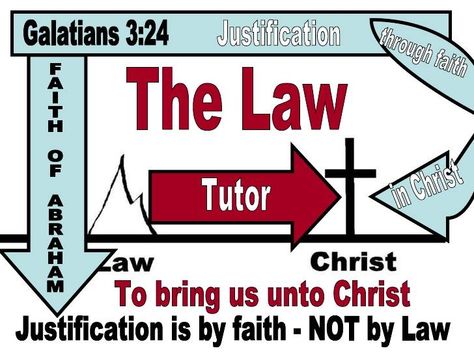
First, Israel was confined under the law, which functioned like a guardian (or tutor or governess). Until Faith came, this provided restraint and guidance but could never give the inheritance (3:18).

Second, A great movement of faith came with Jesus. 

Third, whenever and wherever men and women give their lives to Jesus they are justified, and become children of God, regardless of who they are. 

Fourth, therefore, we who have accepted Jesus as Savior are heirs of His promise to Abraham.

law


  • Confined Under Law


The first point is taken in verses 23 and 24, “Now before faith came, we were confined under the law, kept under restraint until faith should be revealed. So that the law was our guardian until Christ came.” The word translated as guardian comes from the Greek word paidagogos (pahee-dag-o-gos) and can be translated as schoolmaster/ custodian and refers to a servant of the family responsible to watch over the son, from the nursery to his entrance into manhood. He governs the child’s behavior and instruction until the child has the maturity to do what is right without external constraints. The child was not allowed so much as to step out of the house without them before arriving at the age of manhood. However, No matter how important this person was, the paidagogos does not have the power to make the child’s heart good, nor can he give the child his inheritance.

That’s how the law functioned for Israel. It provided direction and restraint. It showed the way a mature child should behave. But it could not give Israel a new heart nor could it give the inheritance. And according to 

Hebrews 4:2 the reason the law did not benefit Israel was that it did not meet with faith. Faith is the mark of maturity, which the law prescribed, and so the law kept Israel under restraint until faith came.

 The purpose of the law was to instruct Israel how to live a faithful life in the promises of God but their response was more often than not rebellion. Israel, for the most part, did not humble themselves, and so the law functioned to expose Israel’s sin and hold them under restraint until the day when God began to take away the blindness and give them a heart to trust Him.

And the law works that way today, too. If you are not truly trusting God and relying on mercy, the law feels burdensome, offensive, like the assignments given by a harsh taskmaster. But if you trust God with all your heart and rely on his mercy, then the law will feel like a prescription from a wise Physician, like exactly what you need. What the law is for you depends on what you are toward the Law-giver. 

1 John 5:3 says, “This is the love of God, that we keep his commandments. And his commandments are not burdensome.” 

faith has come


  • Faith Has Come


The second point in Paul’s thought is that faith has now come. It’s coming is simultaneous with the coming of Christ. Verse 25, “But now that faith has come, we are no longer under a guardian.” What does he mean: “Faith has come”? He doesn’t mean that no one in Israel had saving faith before Christ came. Abraham did. Psalm 32 portrays a man whom the Lord reckons righteous by faith apart from works. Hebrews 11 gives a believers’ hall of fame from the time of the law. So Paul does not mean that no one had faith before Christ came, nor that justification was by works before Christ came. No one can earn it, it has to come by faith. There were believers who were justified by faith all along, 7,000, Paul says, in the time of Elijah in his letter to the Romans (11:4)

gal 3-24

So what Paul means when he says that “faith has come,” is that by God’s grace a period in redemptive history has come in which great numbers of people, especially Gentiles, are responding to God’s Word in faith. “Faith has come” means that a great movement has begun whose members are marked by this above all else—they trust like little children in the mercy of God. When the law was preached, it met with very little faith. But when the gospel is preached, many people believe and are saved. This movement has spread around the world. The reason for this is not that the law taught men to earn salvation while the gospel offers salvation freely to faith. No, both the law and the gospel offer salvation freely to faith, and both describe the obedience that shows the genuineness of this faith.

The reason why the law seemed to mostly shut people up in sin while the gospel wins faith from large numbers is that the preaching of the gospel is accompanied by a powerful work of the Holy Spirit to open the hearts of the listeners. The cross brought a change in relationship between people and God while the Holy Spirit brought power. (Acts 16:142 Corinthians 4:6). “Faith has come” means that God is fulfilling the promises of Ezekial 36:26 “I will give you a new heart and put a new spirit within you. If God were not causing the gospel of Christ to be accompanied by the convicting, opening work of the Spirit, the gospel would shut us under sin just like the law did. But that was not God’s plan. And every one of us here who lives by faith in the Son of God is living evidence that by the sovereign, effectual grace of the Holy Spirit “faith has come”—even to us, and taken up residence in our hearts, and made us new. If you know the hardness of your own heart apart from renewing grace, you know to  thank God every day that you are a believer.

united.jpg


  • United to Christ


The third point in the text is that faith in Christ so unites us to him that all the benefits he can give become ours. This harkens back to the picture of the loving father and the Prodigal Son. Though the son did not deserve it,  the love of the father wrapped the son in both his arms and His robes

That’s how it is with Christ. If you entrust yourself to Christ, and say you want to be his eternal guest, and wear his garments, and accept his customs, because of his love, Because of the cross, the father would be denying himself in the work of Christ to turn you away. And so all he has is yours. Foremost in verse 24 is justification—that is, acquittal of all guilt, forgiveness of all sin.

8_forgiveness-complete

It is important to understand this is complete forgiveness without any restitution on our part. We understand justice has been served when someone has paid his debt to society such as doing time in prison, a fine, etc. We pay nothing, we have no requirements outside of faith for this justification.  However in this justification Jesus paid our debt to God on the cross. Then, as verse 26 says, sonship and daughtership becomes ours. To belong to Christ is to be a child of God with all the stupendous privileges implied in that relationship. The idea here of baptism is amazing. It is a deeper meaning than just having been water baptized.

immersed

The Greek Word Baptizo means to be immersed, and so Paul isn’t saying just to be baptized, but to be baptized in Christ, to be immersed in Christ. 

When we are immersed in Christ, we are changed. It doesn’t matter what we were before. The reason is we have put on Christ like a garment, again that image from the prodigal son where the father covers the dirt and filth with His robe, Jesus covers all of our filth with Himself. Verse 28: “There is neither Jew nor Greek, there is neither slave nor free, there is neither male nor female.” Every possible ground for boasting is removed; every possible reason why we shouldn’t receive it is also removed. We are immersed in the cleansing and saving power of the cross and all who go through that power are changed and are part of the same family. Whatever our differences, racial, social, economic, whatever, we are all utterly dependent on the power and love of Christ, not the value of our distinctiveness. There is nothing more secure.

heirs to the promise


  • Heirs to the Promise


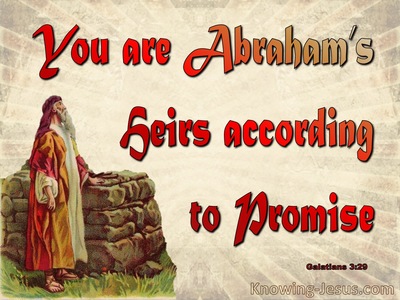
Finally, the fourth point is simply this: we are heirs to the promise. Verse 29: “If you are Christ’s, then you are Abraham’s offspring, heirs according to the promise.” To be a descendant of Abraham and to be a child of God are virtually the same in Paul’s mind. You become both when you entrust yourself to Christ and say, “I want to be yours.” I already mentioned the idea of sonship, with that comes inheritance. The promises of God are for those who are in his family. 

In Genesis 12 God told Abraham I will bless you and make your descendants into a great nation. You will become famous and be a blessing to others. I will bless anyone who blesses you, but I will put a curse on anyone who puts a curse on you. Everyone on earth will be blessed because of you. 

covenant

Later this was established again in covenant when Abraham was 99 years old. We see this in Genesis 17 :  I will always keep the promise I have made to you and your descendants, because I am your God and their God. I will give you and them the land in which you are now a foreigner. I will give the whole land of Canaan to your family forever, and I will be their God.

We are part of the fulfillment of God’s promise to Abraham as well as recipients of His Promises to His people. If you are Christ’s then you are Abraham’s heir. This place of high privilege comes according to the promise, not according to law or works.

family eternity

Because of Christ, we are connected with the long line of God’s people assembled throughout all the ages.This promise is only for those united by the blood of Christ, and if we are Christ’s, then we find our place in eternity, because we are sons and daughters of God. 


walk to emmaus

Several years back while on a Walk to Emmaus retreat, God reminded me of  a night I was at a service in Mexico. I had come to think because of many reasons, the biggest being my failed marriage that though Salvation was there for me, I was damaged goods and not good enough to be used in ministry any longer. During this moment God reminded me of a night in Mexico when I was pouring my heart out to Him as a young man distraught with his own shortcomings and inadequacies looking into the face of what God wanted Him to do explaining why I was not the right man, in much the same way Moses did, God reminded me what HE told me then. I was never worthy or good enough to begin with. It has nothing to do with my worth and everything to do with His Grace. When He called me, He knew the path my life would take, and though I had free will, HE knew the choices I would make, and would give me promises anyway, promises that HE stood by, He wanted to know would I believe those promises and continue to walk toward them and lay hold of those promises. The journey of my life has taken shape in ways I never expected, there have been highs and lows and many in between that over time I am sure you will hear about as we grow in this new relationship. Yet through all of that nothing has changed regarding God’s promises.


Slide1

The fact I am pastoring two churches, writing a blog, Doing ScriptureTalk Live!   (an online interactive bible study Mondays at 6pm Central time archived episodes is available) is all because of God’s faithfulness to his promises.

So we find our place in society, because we are brothers and sisters in the family of God, and we find our place in history, because we are part of God’s plan of the  ages. A plan that cannot be stopped by anything or anyone. 

God never goes back on His word or His purposes. I challenge you to dig into His word and see the promises that are written to you, if you are immersed in Christ, these are promises to you. Dust off the old prayer journal, what promises has God spoken over your life? What promises has He spoken over your family? This church? This city?  We are at least 3000 years from when God gave Abraham his promise, and yet God is still showing Himself faithful to that promise, do you think He is going to start being unfaithful now? No we are heirs to the promise just as we are evidence of the promise. Start laying a hold of those promises by faith and let’s look with expectation for what God is going to do next.

Pentecost

pentecost-300x188Pentecost Sunday is a remembrance and celebration of when God poured out His Holy Spirit upon the early church. When He did this, he was fulfilling what John the Baptist foretold when he said there would come later one who baptized with the Holy Spirit and with fire (Matthew 3:11).

 

This was also a fulfillment of the promise Jesus made to His disciples regarding HimJohn 14 image sending a comforter, the Holy Spirit (John 14:26).
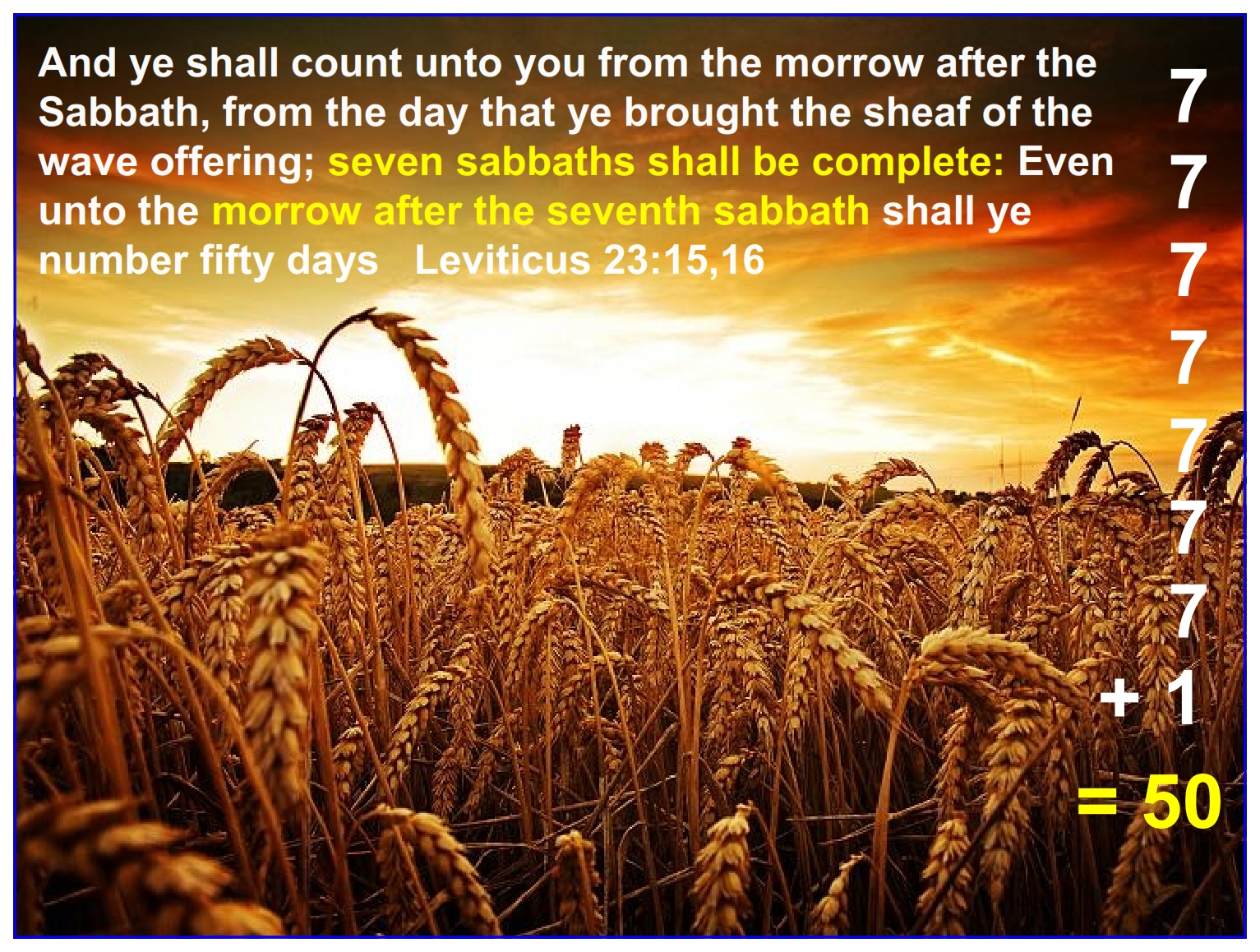
But neither of those are the reason it is called Pentecost. For this reason we need to look back at the foundation of the Christian belief, Judaism. Jesus and the disciples were Jewish. They observed and celebrated the Jewish Feasts.  There are seven feasts celebrated, but three main feasts. The three main feasts are: Pesach (Passover), Shavuot (Weeks or Pentecost), and Sukkot (Tabernacles, Tents, or Booths).

feast of weeksCelebrating the Feast of Pentecost is why the Apostles and other disciples of Jesus were gathered together in the upper room. The word Pentecost comes from  Greek Πεντηκοστή (Pentēkostē) meaning “fiftieth” (50th). It is called this because this feast takes place 50 days following Pesach (Passover).
Biblically speaking this feast is tied to the grain harvest, specifically wheat.  This harvest lasted seven weeks and was considered a time of joy (see Exodus 34:22, Deut. 16: 9-11, Isa. 9: 2 Jer. 5:24). It was the first day that the people could bring the first fruits as an offering to the Lord.

Later in time it would become associated with the giving of the Torah, or Law, to Israel at mosesMt. Sinai, following their salvation from Egypt. This is largely because of its association with Pesach (Passover) and the obvious ties to the Exodus through Moses and the subsequent giving of the Torah to the Israelites.


acts-birth-of-a-churchIn the New Testament, Pentecost is looked at as the birth of the church. It was this event that Jesus referred to when He told the disciples,  “Do not leave Jerusalem, but wait for the gift my Father promised, which you have heard me speak about.  For John baptized with water, but in a few days you will be baptized with the Holy Spirit” (Acts 1:4, HCSB).

The 1st chapter of Acts tells us there were 120 gathered together. Luke then describes in tongues of firechapter two the Holy Spirit falling upon them with what looked like tongues of fire. It says they were all baptized with the Holy Spirit and spoke in other languages or tongues. Peter later testifies in front of the crowd that this gift of the Holy Spirit is the fulfillment of Joel 2:38-32.

“this is what was spoken through the prophet Joel: And it will be in the last days, says God, that I will pour out My Spirit on all humanity; then your sons and your daughters will prophesy, your young men will see visions, and your old men will dream dreams. I will even pour out My Spirit on My male and female slaves in those days, and they will prophesy. I will display wonders in the heaven above and signs on the earth below: blood and fire and a cloud of smoke. The sun will be turned to darkness and the moon to blood before the great and remarkable Day of the Lord comes. Then everyone who calls on the name of the Lord will be saved” (Acts 2:16-21)

foxes-book-martyrs-470x246-01Foxe’s Book of Martyrs

The gift of the Holy Spirit is the catalyst that changed the disciples forever.  The truth of the resurrection was burned into their hearts and the group of men who scattered during the arrest and crucifixion, the men who denied with cussing that they even knew Jesus, went on to each give their lives, literally, to see the world turned upside down. Check out the above link for how each disciple gave their life as well as other Christians.

This was the birth of the church, we were to grow and prosper since that time. In many ways we have, in others we have grown stagnant. We need a fresh infilling of the Holy Spirit in order to truly live out the final instructions of Jesus to His church. It is a because of having access to the Holy Spirit that we will be able to do the things Jesus did, and even more, as according to what Jesus said in John 14.

This is why we celebrate the gift that is the Holy Spirit on Pentecost Sunday. May it be more than a side comment or even a potluck dinner to commemorate it. Let it be a push to seek for more of the Holy Spirit and fire operating in our life so that we can make a difference in the world.

change

Gluten Free, Keto approved Pizza

I gave a new recipe a try this week, and I have to say I loved it.  I am sure everyone can Slice of hot pizzaagree that there is very little that can compare to wonderful ooey gooey goodness that is pizza. I mean sometimes you just crave and need that hot, melty, rich flavor that only comes from biting into a slice of Italian pie.


However our life changed awhile back when my wife developed Celiac disease. For those who do not know, this is an extreme allergy to Gluten. Gluten is a substance found in cereal grains, especially wheat that is responsible for the elastic texture of dough. gluten freeEssentially it is a mixture of two proteins and is what causes illness in people with celiac disease. Think extreme abdominal pain due to swelling intestines that prevent proper absorption of food. It also causes severe rash breakouts along with other fun things. So needless to say all bread products, regular pasta, anything with MSG, etc. have been off limits.


keto batman

In addition I have adopted a Keto style diet as I am trying to get in better shape (43 lbs down so far and still going!)  So this has meant a no to pizza. Yes we have cried crying


Well my wife has been craving pineapple and ham pizza. I know you haters are going to hate, however she enjoys it and quite honestly so do I. I mean if you haven’t tried it, you need to,  i mean look at it:

pineapple pizza

So anyway, I set about on creating a pizza she and I could both enjoy. I have attempted various things as a substitute crust, cauliflower crusts, gluten free tortillas, and so far nothing really gave that awesome, comfort giving pop of flavor in the mouth that comes from real, honest to goodness pizza.

celebrating emoji

However, that all changed this week. I found a gluten free and Keto approved (depending on your choice of toppings)

The crust I made used a Fathead dough recipe (which is below). I refrigerated the dough for about 10 minutes before rolling it out. Place Saran Wrap over it to roll it out, I didn’t lol. It wasn’t difficult to get the parts off the rolling pin, but I am sure the plastic wrap would make it go smoother.

While the crust was in the oven I sliced some fresh pineapple grilled pineappleand put it out on the gas grill. Nothing on the pineapple, and just sprayed the grill.

The pizza sauce was a homemade marinara that I had made previously (I will post recipe late and insert link so check back J)


When the 13 minutes was up on the crust I took it out and let it cool a bit while I finished hamthe pineapple.  From there it was simple. I spread the sauce on the crust. I then sliced some ham and placed on the pizza. I used a nitrate free ham sandwich meat ( I used Natural Choice).


I chopped several slices of the pineapple and covered the ham with it. On top of that I grated mozzarella cheese and placed it back in the oven (be sure to lower temp to 350 from 425 temp used with crust) and waited for the cheese to melt.

It was great! Though the crust tastes amazing, it is a slight different texture than standard bread crust, but it was defiantly pizza.

homemade pizza

glazed pineappleI actually had leftover pineapple slices so I melted some butter and coconut sugar in a skillet with just a splash of water and glazed the remainder pineapple as a dessert for everyone else.


This was a big hit and will definitely be a repeat at our house. I did however learn a few things. I had covered my pizza pan with aluminum foil because I was afraid the dough might slip through the holes in the pan. This would not have been a problem and since I forgot to spray the aluminum foil, it caused some minor sticking issues. Next time I will not use the foil and will probably use my pampered chef stoneware (my wife reminded me about this after the fact, where was she with the great ideas when I started cooking? LOL). She was quiet pleased to have her pizza fix.

I hope you enjoy. You can obviously substitute any toppings you want on this crust.


Fat Head Dough Recipe

Ingredients:

  • 4 oz. cream cheese
  • 1 ½ cup shredded mozzarella
  • 2 eggs
  • ½ tsp garlic powder (or to taste, I add a bit more because I LOVE garlic)
  • 2/3 cup almond flour
  • ¼ cup parmesan cheese

Instructions:

Preheat oven 425

In a double boiler melt the mozzarella and cream cheese. I do not own a microwave (long story for another time) but you could use a microwave for this step. I would suggest about 15-25 seconds at a time and stir.

Add remaining ingredients to the melted cheese.

Mix it well. This will take a bit of stirring as melted mozzarella is interesting to work with. I would have to unstring it from my spoon, but it worked out without too much effort. Next time I will try the dough attachment on my Ninja mixer.

Grease a pizza pan, or use stone ware. Spread dough out in a circle to about ½ “thickness.

Bake 13-15 minutes or until golden brown.

Pile it up with your favorite toppings. If you have not tried it I suggest pineapple and ham. Jalapenos and bacon are another favorite around here.

Nutrition facts :

Serving size, cut pizza in 8 slices and serving size is two slices… because no one eats just one slice of pizza. But if you do, (yeah right) just divide this by 2.

Calories  302

Fat(g)      26.1

Carbs      5

Fiber       1.4

Protein    15.7

As Julia Child would say,

julia child


The Five “One Things”

The Five “One Things”. 

ONE is particular, specific, and separate.

It stands alone. Regarding numbers it is the principle primary number. It emphasizes significance, an unmistakable quality, and total autonomy.

In this crazy passed world, with its ups and downs and multiple things competing for our attention, it is important to pause and consider what is important. Evaluate priorities.

bible-gateway   When I performed a keyword search on the Bible Gateway website, I found the phrase “One Thing” was used 11 to 18  different times in Scripture depending on the English translation.

There are 5 that kept popping up regardless of the translation that really stood out to me that will be the focus of this lesson, The 5 “One Things”

  1. Psalm 27:4

“I have asked one thing from the Lord; it is what I desire:
to dwell in the house of the Lord all the days of my life,
gazing on the beauty of the Lord and seeking Him in His temple.”

King David is often called a “man after God’s own heart.” He chased and pursued man after God'sintimacy with the Father, sought His heart and desired to be made in God’s image over everything else he could want or desire. When He was confronted with his sin and mistakes, unlike Saul who wanted to be honored in front of the people, David was concerned with not losing the presence of God. Something interesting to point out, when David wrote this, the Temple had not been built yet. It seems David had a glimpse of the Temple not made by human hands where he could dwell with God forever. This is the one thing he sought.

  1. Mark 10:21

21 Then, looking at him, Jesus loved him and said to him, “You lack one thing: Go, sell all you have and give to the poor, and you will have treasure in heaven. Then come, follow Me.”

rich young rulerThe Rich young ruler only lacked one thing. He could not part with his possessions and wealth. There are many reasons this could be, maybe he lacked faith for God’s provision. Maybe it was the fear of losing everything, losing the status his position and wealth brought him. He may have considered, “what might everyone else think?”


 

surrender

Whatever the reason was, he did not give everything to Jesus. One thing He lacked was total submission of every area of his life being given over to Christ.


  1. Luke 10:42

42 but one thing is necessary. Mary has made the right choice, and it will not be taken away from her.”

Mary and Martha are two sisters that were close to Jesus. During a particular gathering at their home, Martha was very busy tending to the things to insure the evening went well as a good host would. However when she complained about her sister, an interesting point was made by Jesus. The one thing that is necessary is being with Jesus. Seek First the kingdom of God and all these things will be added to you. Jesus is the physical representation of God’s Kingdom. So Seeking Jesus is the one thin that is necessary. There is no other way to the Father, except through Him. I have often heard it said, the greatest enemy to great, is good. Martha was doing good things, but Mary had chosen that which was better.mary or martha

Are you Mary or Martha? Click to find out.

  1. John 9:25

25 He answered, “Whether or not He’s a sinner, I don’t know. One thing I do know: I was blind, and now I can see!”

blind but nowWe see the story of a man that was born blind. The religious leaders are stuck on being offended by Jesus healing on the Sabbath and not on the miracle. As they question the man, he doesn’t try to convince them of anything or have a well prepared apologetics response. It is O.K. to tell people I don’t know.  He tells them what he knows. I was blind, and now I see. To all the questions He had one focus. Revelation 12 tells us that they [the saints] overcame by the blood of the Lamb and the word of their testimony. There is no greater apologetics or reply that we can give to anyone besides the truth, especially when that truth is the power of God working in our life. We should focus on what God has done in our lives.


  1. Philippians 3:13

13 Brothers, I do not consider myself to have taken hold of it. But one thing I do: Forgetting what is behind and reaching forward to what is ahead, 14 I pursue as my goal the prize promised by God’s heavenly call in Christ Jesus.

goalsetting5Paul did not let his past determine his future. He had a goal and he went after it with a singular purpose. Nothing was going to keep him from his goal.


These five verses showed 5 different people, from 5 different backgrounds, but at the heart of each story is one thing we need to grasp.

  1. Through David we see that knowing God is at the heart of prayer.
  2. Through the Rich Young Ruler we see that knowing God is at the heart of total surrender.
  3. Through Martha we see that knowing God is at the heart of service.
  4. Through the Blind man we see that knowing God is at the heart of witness.
  5. Through Paul we see knowing that God is at the heart of ambition.

The One Thing we need is a singular focus on Jesus in every aspect of our lives. Not just on Sundays, not just around our church friends, but everyday, everywhere we may be.

need jesus


Apologetics? What is it?

Apologetics is defined as reasoned arguments or writings in justification of something, typically a theory or religious doctrine. It is the aspect of theology that deals with the defense and establishment of the Christian faith. It is NOT apologizing for a faith in Christianity. It is simply defined as defending the faith, or as J Warner Wallace puts it, “Christian case making.” I like that better because God does not need someone to defend him against anyone, but other people need guidance and help in understanding.

god doesn't need defending

The word, “apologetics,” comes from the Greek word, “apologia,” pronounced “ap-ol-og-ee’-ah.” It means “a verbal defense.” It is used eight times in the New Testament: Acts 22:1, 25:16, 1 Cor. 9:3, 2 Cor. 10:5-6, Phil. 1:7, 2 Tim. 4:16, and 1 Pet. 3:15.

1 Peter 3:15 is the verse that is most used as to the reason all Christians should be familiar with Apologetics.

15 but honor[ the Messiah as Lord in your hearts. Always be ready to give a defense to anyone who asks you for a reason for the hope that is in you.(HCSB)

Verse 16 goes on to give direction regarding how and why.

16 However, do this with gentleness and respect, keeping your conscience clear, so that when you are accused,[those who denounce your Christian life[d] will be put to shame.
Always be ready to give a defense to anyone. Right there in a nut shell is the instruction for all Christians to be knowledgeable in apologetics. Now this does not mean everyone needs to go to college and earn a degree in Christian Apologetics. However it does mean everyone should know what they believe and why they believe it.

There is a story I tell my students when I a stressing the importance of knowing why the believe something and not just take other people word for things. I would like to share it.

A young girl is in the kitchen with her mother learning to cook. This particular meal they are making a ham. As she carefully watches what her mother does, she asks,”Why do you cut the ends off the ham?” After a slight pause the mother replies,” I really don’t know. This is just how my mother did it.” “oh, ok.”
Later in the week the mother is on the phone with the grandmother discussing this and that when she remembered her daughters question.
“Hey mom, Sarah was helping me with the ham the other day and asked a question i just never really thought of before, why do we cut the end off the ham before baking it?” “Well gosh Honey, I really don’t know either, that is just the way I was taught by mom.” This Great grandmother of this family was still alive and as the curiosity built up regarding this mysterious technique, Sarah’s mom called the great grandmother, posing the same question.
“Nana, why do we cut the end off the ham before baking it.” After a considerably amount of laughter, she answered,” Oh child, you don’t have to cut the ends off the ham. I used to do that because I didn’t have a pan large enough for the whole ham to fit into and Papa liked sandwiches made from the end pieces for his lunch.”

Not knowing why you believe what you believe can lead to doing things or holding on to ideas that are not relevant. So Apologetics not only allows us to tell others about our beliefs, it helps increase our faith because it builds a more solid foundation of what we believe, and why we believe it.
Great Apologetic resources:

https://carm.org/introduction-apologetics

http://www.thepoachedegg.net

https://answersingenesis.org

http://www.josh.org