

The Bible is often the subject of much debate. One of the key topics surrounds the idea that the Bible is more than just a book, but is the Word of God. The Bible is spoken of as “inspired”, but what does this mean?
If we go to a dictionary, we will find:

-
1.of extraordinary quality, as if arising from some external creative impulse.“they had to thank the goalie for some inspired saves”2. (of air or another substance) that is breathed in.
When people speak of the Bible as being inspired, they are referring to the fact that the Human authors of the Bible were influenced divinely and the words they wrote were literally the words of God. This does not mean that God took over the authors and wrote through them like an automaton, but that His will flowed through them, using their personality and writing style to convey His words in scripture.
 2 Timothy 3:16 states, “All scripture is inspired by God, and is profitable for teaching, for rebuking, for correcting, for training in righteousness.”[1] The word translated as inspiration, is qeopneustoj (pronounced theh-op’nyoo-stos)[2] is sometimes translated God-breathed. It literally translates as breathed out by God.
In other words, scripture is the result of the Holy Spirit working through men.
In the afore mentioned scripture, Paul clarifies to what extent it is inspired by God, all  scripture. This idea is reinforced by Peter in his letter to the churches in Asia. 2 Peter 1:20-21, Peter writes, “First of all you should know this: no prophecy of scripture comes from one’s own interpretation, because no prophecy ever came by the will of man; instead men spoke from God as they were moved by the Holy Spirit.”[3]
Paul is telling his readers that the prophecy of scripture is not just what man thinks God is saying due to his own interpretation, but is actually God speaking through men, using their gifts and words , guided by the His Spirit. So Peter and Paul both believed scripture was straight from God, not man, therefore emphasizing the importance and infallibility of scripture.
Jesus Himself expressed this idea regarding scripture in Matthew 5:17-18, “Don’t assume that I came to destroy the Law or the Prophets. I did not come to destroy but to fulfill. For I assure you: Until heaven and earth pass away, not the smallest letter or one stroke of a letter will pass from the law until all things are accomplished.”[4] In this scripture, Jesus is attesting to the infallibility of scripture and stating that not one aspect of scripture will fade away until it has all been fulfilled.
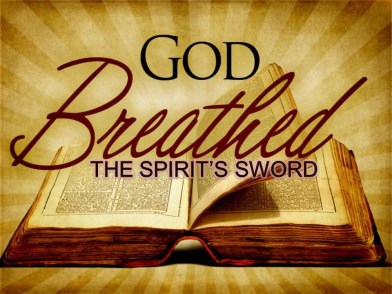 Jay Adams sums up what is meant by “inspired” or “God-Breathed” when he writes, ” When God says that He breathed out His Word, He means that what is written is as much His Word as if He had spoken it audibly by means of breath.”[5]
Try to find any other collection of 66 books, written by over 40 different authors, spanning a period of over 1500 years and see if they fit together to tell one complete story, weaving together without true contradiction or loss of theme.

[1] Bible Gateway passage: 2 Timothy 3:16 – Holman Christian Standard Bible. (n.d.). Retrieved October 10, 2016, from https://www.biblegateway.com/passage/?search=2 timothy 3:16
[2] KJV w/ Strong’s Concordance – 2 Timothy 3. (n.d.). Retrieved October 10, 2016, from http://www.godrules.net/library/kjvstrongs/kjvstrongs2tim3.htm
[3] Bible Gateway passage: 2 Peter 1:20-21 – Holman Christian Standard Bible. (n.d.). Retrieved October 10, 2016, from https://www.biblegateway.com/passage/?search=2 peter 1:20 -21
[4] Bible Gateway passage: Matthew 5:17-18 – Holman Christian Standard Bible. (n.d.). Retrieved October 10, 2016, from https://www.biblegateway.com/passage/?search=matthew 5:17-18
[5] Jay Adams, A Theology of Christian Counseling, p.17
 A Rock Between The Eyes