

Growing up in Biloxi, Mississippi offered many enjoyable opportunities as a child, the cuisine I enjoyed as a child was among the highlights. Being lavished with Cajun and Creole offerings on the table and saturated with other delectable offerings of fine Southern homestyle cooking, it is no wonder I developed a love of cooking and food in general. It helped that my dad and great uncle (who lived just around the corner) were excellent cooks in their own right. My life experiences that included traveling In France, England, moving to the great state of Texas, as well as spending two entire summers living in Queretaro, Mexico, added to my culinary intelligence. Nevertheless my heart still belongs and will ever hold Cajun and Creole cooking as my favorite.
As I have lived and watched life around me, especially regarding food trends and tastes, it seems the word Cajun and Creole have become synonyms in the way they are used, especially when describing food. A restaurant will add a new menu item and label it “Cajun”. Unfortunately this usually just means they tossed a bunch of Cayenne pepper or other type of sauce to make it spicy and voila it is a Cajun dish.That is not the case, nor does “blackened” mean burnt (Think very high heat and meat covered in a spice mixture).Therefore I feel the obligation to post regarding this topic and set the record straight (as many others have done) regarding these two different styles of cooking.
Let’s start with a brief history lesson.
Cajuns were French Acadians expelled for their Catholic beliefs in the 1700s from what is now Nova Scotia. Many settled in Acadiana, 22 parishes (counties) in southwest Louisiana. Surrounded by swamps, bayous and prairies, the Cajuns were isolated and lived off the land. The word Cajun derived from shortening the word Acadian very similar to how Indians were once called “Injuns” . The culture remains vividly alive and intense. This is evident in their language (a unique dialect of French), music and of course in the rustic, hearty cuisine.
In contrast, Creoles, were city folk that originally hailed from Europe and then settled in New Orleans. Predominantly Spanish and French, Creoles descended from wealthy families. The brought their own chefs from Madrid, Paris, and other European capitals. These chefs adapted classic cooking techniques to incorporate unfamiliar ingredients like mirliton, crawfish, pompano, snapper, and others. The African slaves who served in these homes added their own flavor as well as the influence of Choctaw Indians and immigrants from Ireland and Germany. All of these thrown together create a true melting pot of flavors, especially in Gumbo.

To be fair it is understandable how there can be some confusion regarding Cajun and Creole, because they can deal with the same dishes. The ingredients used will determine if a Gumbo is Creole or Cajun. That being said there are always going to be some crossovers and similarities regardless of the style and of course the individual preference and personal touch of whomever is creating the dish.
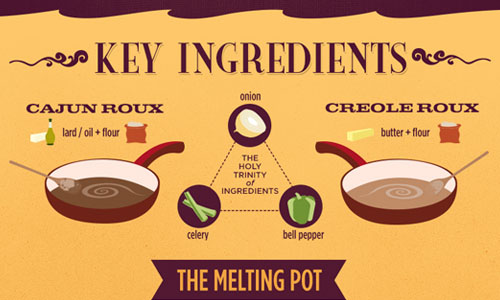
That being said, certain ingredients are a must, namely the trinity. If you are familiar with cooking then you know what a mirepoix is. A roughly chopped vegetable mixture, usually consisting of onions, carrots, and celery a 2:1:1 ratio respectively. The trinity refers to the Cajun and Creole version consisting of onions,celery, and green bell pepper in a 3:2:1 ration. Around my house garlic was always added to this therefore making the base of many different dishes and roux.
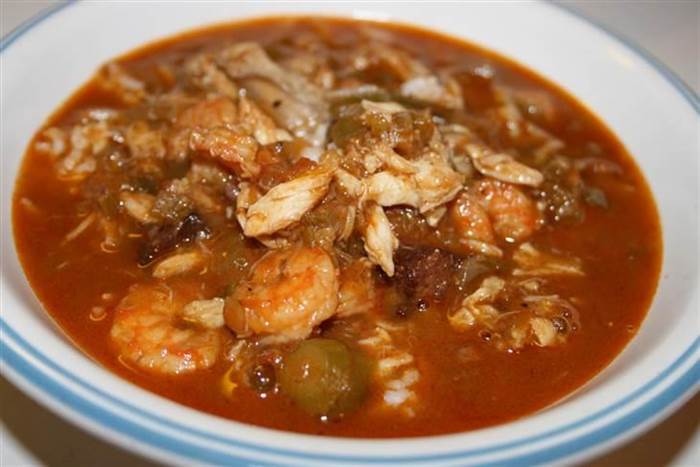
 Cajun Seafood Gumbo
Let’s look at the differences that make the distinction between the two styles. The reason For the earlier history lesson was not just extraneous information but showing the background as well as pointing out what brings us to the true Gumbo test regarding Cajun vs Creole. Access to ingredients. The true simple, in a nut shell answer is that Cajun vs Creole is really City food vs. rural. So money and access determined what was used, even when cooked in similar fashion.
An excellent article by food and travel writer Beth d’Addono summed it up nicely with a Quote from executive chef Mark Falgoust:
“Cajun folks used one chicken to feed three families, Creoles used three chickens to feed one family,” said chef Mark Falgoust, executive chef at Grand Isle restaurant across from the Convention Center and Harrah’s Casino. Although a native New Orleanian, Falgoust’s family roots are in Bayou Pigeon and Pierre Part and he’s Cajun through and through. “Our people held onto our culture. We had big families, hunted and fished, and didn’t use fancy ingredients or dairy in our food. To me, Cajun isn’t a bloodline, it’s a state of mind.” A Cajun gumbo typically is made with a darker oil-based roux and homemade sausage and chicken as well as seafood. “People think Cajun food is all spicy, but that’s not true at all,” said Falgoust. “Creole cooking is more refined all around. Creole gumbo uses butter in the roux, tomatoes and usually just seafood, no meat.”
( the entire article can be found at http://www.10best.com/interests/foodie/cajun-vs-creole-cuisine/)
There it is. The way I was taught growing up, is the same difference the professionals state. The richer butter and tomato based dishes are Creole, with the Creole Gumbo being more like a soup. The darker oil based roux and just about any meat you can catch, is Cajun with the Cajun gumbo being thicker and more like a stew. This is just depends on the type of thickening agent used and if File seasoning was added or not.
The main seasonings used in the various dishes are also similar with some exceptions such as Creole usually adds oregano. This, coupled with too much salt, is the reason there is not much flavor difference between the Cajun seasonings and the Creole seasonings you buy in the store. You would be better served making your own, which also allows you to add your own personal touches. A Recipe for making your own is below.
Now you are among the elite who know the basic difference between Cajun and Creole and that highly seasoned does not just mean spicy. Go out and explore these culinary delights and experiment with the two styles. But please remember, if it doesn’t have okra, it is not Gumbo.
For more information regarding Cajun vs Creole check out:
http://www.louisianatravel.com/articles/cajun-vs-creole-food-what-difference
http://www.huffingtonpost.com/Menuism/cajun-vs-creole_b_1447822.html
Making your own Cajun seasoning is easy, and turns out better than store bought mixes:
Makes about 1/2 cup
INGREDIENTS
Kosher or sea salt — 2 tablespoons
Paprika — 2 tablespoons
Thyme — 1 tablespoon
Basil — 1 tablespoon
Garlic powder — 2 teaspoons
Onion powder — 2 teaspoons
Black pepper — 2 teaspoons
White pepper — 2 teaspoons
Cayenne pepper — 1 teaspoon
Just mix all the ingredients together and store in a cool dry place.
If you want it to be “Creole” then add 1 tablespoon of Oregano to the mix.
If you want it spicer, increase the Cayenne, or add 1 teaspoon of crushed red peppers to the mix.
 A Rock Between The Eyes