
Do You Know The Master?

My Church was doing a Wednesday night series over the Parables of Jesus. Last night I shared over the Parable of the Talents and wanted to post it as I learned some really great things during this study.

The Parable of the Talents Matthew 25:
14 “For it is just like a man going on a journey. He called his own slaves and turned over his possessions to them. 15 To one he gave five talents;[c] to another, two; and to another, one—to each according to his own ability. Then he went on a journey. Immediately 16 the man who had received five talents went, put them to work, and earned five more. 17 In the same way the man with two earned two more. 18 But the man who had received one talent went off, dug a hole in the ground, and hid his master’s money.
19 “After a long time the master of those slaves came and settled accounts with them. 20 The man who had received five talents approached, presented five more talents, and said, ‘Master, you gave me five talents. Look, I’ve earned five more talents.’
21 “His master said to him, ‘Well done, good and faithful slave! You were faithful over a few things; I will put you in charge of many things. Share your master’s joy!’
22 “Then the man with two talents also approached. He said, ‘Master, you gave me two talents. Look, I’ve earned two more talents.’
23 “His master said to him, ‘Well done, good and faithful slave! You were faithful over a few things; I will put you in charge of many things. Share your master’s joy!’
24 “Then the man who had received one talent also approached and said, ‘Master, I know you. You’re a difficult man, reaping where you haven’t sown and gathering where you haven’t scattered seed. 25 So I was afraid and went off and hid your talent in the ground. Look, you have what is yours.’
26 “But his master replied to him, ‘You evil, lazy slave! If you knew that I reap where I haven’t sown and gather where I haven’t scattered, 27 then[d] you should have deposited my money with the bankers. And when I returned I would have received my money[e] back with interest.
28 “‘So take the talent from him and give it to the one who has 10 talents. 29 For to everyone who has, more will be given, and he will have more than enough. But from the one who does not have, even what he has will be taken away from him. 30 And throw this good-for-nothing slave into the outer darkness. In that place there will be weeping and gnashing of teeth.’

I am sure many have heard this story before. I have heard it shared many times in the past and have read and reread it multiple times since, especially the past few weeks. I have also read more commentaries on it than I care to remember. The usual message I have heard on it relates to God giving us talents that we are to put to use for His glory. This is a great message, biblically sound because that is exactly what we are to do with our talents.

There is more to this parable than a great message on using our talents for Jesus. As a matter of fact if you look at the etymology of the English word talent, that’s a fancy word meaning the study of the origin of words, our usage of the word talent actually comes from the common interpretations and teaching on this parable. The only problem is that was not the meaning of the word in Jesus’ Day or how it is used in this parable.
Obviously the story uses talents to represent money. But parables have a purpose which is to illustrate a moral or spiritual lesson. So there is more to this story than meets the eye. The original definition of talent is that it was an ancient unit of weight. A talent in of itself is not a unit of currency.

The talent was the heaviest or largest biblical unit of measurement for weight. There is some debate over the actual modern equivalent due to different cultures having a different weight associated with their talent but an average estimate is around 75 lbs would be the weight equivalent of 1 talent. So when using talents you would have a talent of gold, silver, copper, etc. In the parable it just says he gave one 5 talents, one two, and the last only one. It does not say if it is gold, silver or copper. Regardless it was a considerable amount all across the board. One was given 375 lbs, another 150 lbs, and another 75 lbs. This is not something you just walk around with in your pocket. Some scholars estimate the monetary amount could have been up to 20 years salary.

So the master has called these slaves and has given his possessions over to them. Some translations say property. I need to mention the importance of property. Property to the Israelites was tied to the promises of God. It might trace back to the inheritance given when entering the promise land. It definitely represented what was the inheritance to be given to family when one passed away.

Considering this I find it interesting that Jesus does not specify an amount but stresses that a weight was given to each or dare I say a responsibility or a measure of something was given to each.

Now most commentaries and messages focus on what the talents represent. Which is where I began my study into this parable. It says they were given to each according to his own ability. Well regardless of how truthful and how great the interpretation is regarding using our talents for Jesus, It doesn’t make much sense that abilities were given according to abilities.

I spent a lot of time researching and praying over what God wanted me to share about this parable. In this parable Jesus uses a comparison between how the different slaves handled their talents. Two put the talents to good use, One hid the talent. The two were rewarded, the one, not so much. I studied the context of how the parable was told. Jesus is actually speaking to his disciples. They have questioned him about the end times, when to expect everything to come to pass. This parable is set between two other parables and they are all giving examples of what the Kingdom of heaven is like.

The verse preceding this , verse 13 says,
”3 “Therefore be alert, because you don’t know either the day or the hour.[b]
then continues into 14
“For it is just like a man going on a journey.

SO the importance of this parable is tied in part to Jesus stressing being alert in the end times. So what are we to understand the talents to represent? I continued to study digging into the greek for the words ability and at how the comparisons between the different slaves played out. Two put the money to use and one hid his away. They were rewarded and punished accordingly to what they did it seems.

But an important thing to remember in studying the Bible, is context. Everything must be understood in context with the rest of scriptures as well as in its’ own chapter.

But If the point of Jesus’ teaching in the parable of the talents is indeed the effort, faithfulness, or works, then based solely upon the context of this parable, one is confronted with the alarming possibility that the difference between those who enter the joy of the master from those who are cast into outer darkness is simply diligent labor. In short, if these interpretations are taken to their extreme, logical conclusion, they are ultimately teaching a works-based salvation, or if the notion of outer darkness is downplayed, then a works-based way to become more righteous. This is against all that the Bible teaches regarding Grace.

But in looking at all of these things I realized there was something that did fit all this criteria and that the talents could very well represent faith.

ROMANS 12:3
3 For by the grace given to me, I tell everyone among you not to think of himself more highly than he should think. Instead, think sensibly, as God has distributed a measure of faith to each one.

Everyone is given a measure of faith, the more we use our faith, the more it increases. It is our faith that leads us to do works. It is by faith that we are saved and the bible even tells us that faith without works is dead and it is impossible to please God without faith. Even looking at the other parables in Chapter 25, the similarities underscore a message of faith.All of them deal with Jesus at his return; they cover judgement, accountability and the separation of two groups. So they are each in their own way showing how to be ready for when the master returns and keeping faith.

It was at this point The Holy Spirit highlighted something specific to me that I was missing. What he pointed out to me, took this parable to a whole other level.

There is a lot to gain looking at this parable and relating the talents to faith. And honestly we can teach great messages out of this making the talents represent many things, abilities, using money for god’s purpose, opportunities we are given. But The most important aspect in this parable isn’t what they were given, but what they did with what they were given and more importantly why. The motivation behind what caused the slaves to respond and act the way they did is the true gem of this parable.

Jesus’ relating of the servant’s actions and the master’s response showed that this was not a parable about work, money, or getting rewards. Instead, the parable of the talents is a story about motivation and the condition of one’s heart.

This was not a story about money but a parable about relationship. So now let’s look at this parable through that lens.

It says the first went immediately to work, the second did the same but the last hid his away. After a long time the master came and settled accounts. So the first two put that faith to use, the other did not, why the difference in what they did?

The man who had received five talents approached, presented five more talents, and said, ‘Master, you gave me five talents. Look, I’ve earned five more talents.’
21 “His master said to him, ‘Well done, good and faithful slave! You were faithful over a few things; I will put you in charge of many things. Share your master’s joy!’
22 “Then the man with two talents also approached. He said, ‘Master, you gave me two talents. Look, I’ve earned two more talents.’
23 “His master said to him, ‘Well done, good and faithful slave! You were faithful over a few things; I will put you in charge of many things. Share your master’s joy!’

ok let’s observe even though they both were given a different amount, they both put it to use and therefore saw an increase. And they both received the same thing. They were both told well done, good and faithful slave.
Ok a slave doing a job for his master, even a trusted slave as these obviously were, has no rightful expectation of keeping any profit or getting anything in return. He is merely doing what is expected.

What does the master go on and say?

You were faithful over a few things,I will put you in charge of many things. A few? well it is obvious the Master has an abundance . Remember the monetary equivalent we mentioned. But more importantly he said Share your master’s Joy!

So they just got promoted, And then asked to share in the Master’s Joy ? The relationship between them just changed. They were just invited to a closer intimacy. Well this is a parable that uses comparison to highlight it’s point so let’s compare the last slaves actions.
24 “Then the man who had received one talent also approached and said, ‘Master, I know you. You’re a difficult man, reaping where you haven’t sown and gathering where you haven’t scattered seed. 25 So I was afraid and went off and hid your talent in the ground. Look, you have what is yours.’

This slave goes on to explain why he did what he did.

But the Master does not agree or disagree with him in regard to his judgement of his character. Instead he uses the slaves own words against him.
26 “But his master replied to him, ‘You evil, lazy slave! If you knew that I reap where I haven’t sown and gather where I haven’t scattered, 27 then[d] you should have deposited my money with the bankers. And when I returned I would have received my money[e] back with interest.
28 “‘So take the talent from him and give it to the one who has 10 talents.
Telling him,If you believed this, then you Should have put the money in the bank and allowed interest to grow. He was called evil, lazy and tossed out of relationship with the master.

Why did this slave respond differently than the other two who were eager and went to work immediately ?

There is one thing he said that is important to note. He was afraid. Why was he afraid ? He says it was because he knew the master.But is his assessment of the Master true? The master didn’t have to give them anything to use while he was away, he could have even chosen other slaves. If he truly expected to gain where he had no right to gain, he would not have then rewarded the slaves and definitely not ask them into a closer relationship. and share in his joy.

It’s possible this Slave may not have even truly believed what he was saying, but was just making excuses because his actions did not back up what he was saying according to the master. The truth is this slave did not really know his master and therefore allowed his fear to keep him from putting his faith to use. He claimed he thought his master would expect something from nothing and yet he still did nothing. His improper understanding of his master affected how he responded to what the Master truly wanted and therefore his talent, or his unused faith did not produce anything for him because he hid it.

In the same way, for each of us, our understanding of the master, our understanding of who Jesus is affects how we relate to him and therefore affects how we respond to him. Lot’s of things can cause us to have a misunderstanding of who Jesus is, Things that happen in the past, relationship with our parents, or spouses.Events going on around us. Anything that can cause us to think Jesus is a certain way or shake our understanding.

The Bible is the ruler and guide by which we are to learn who the master is.The entire Bible from Genesis to Revelation is the story of a personal God seeking to restore relationship with mankind. The very reason Jesus came was to restore relationship between God and man. This parable shows us what the kingdom of God is like. A master who has left his slaves in charge, left them with a measure of faith.

Our view of God affects our relationship with him. We either trust him and act in a way that shows we trust him and therefore use our faith. Or our picture of who the master is causes us to hold on to our faith allowing fears to keep things hidden away out of sight, not being used , unable to increase. This is something that can affect so many different aspects of our life. Are we willing to take a chance with God?

Truly the word Talent can represent many things: But what do we know about the master? Can we trust him with our our talents, our abilities, our money, our faith, opportunities we are given. our lives, our health, or whatever. Or do we have an understanding of the master that allows fear to cause us to hide these things from him, like the slave who buried the talent

Are we going to put our faith in him and thereby find ourselves invited into a closer relationship?

So the choice is ours. What will we believe about Jesus? Will we use our faith, taking hold of opportunities that we are presented with, will we trust in what kind of master we have and get to share in the master’s Joy or allow fear to cause us to hide our faith away. Do not allow a misunderstanding of who Jesus really is to cause you to do nothing and ultimately miss out. Having faith and then putting it to use brings opportunities for an even closer relationship with Jesus, hiding it will cause even what faith we have to be lost. It is a true use it or loose it situation. What do you know about the Master?


What are you focusing on?


I got up this morning and did my normal morning routine; getting ready for work, drinking coffee, morning reading to my kids, etc. Things ran slow and I got off to work late, get to work and my computer is acting crazy. This school year (I’m a teacher if you didn’t know) has been a crazy one as far as technology goes, basically anything that could break or not work in my classroom has done so, repeatedly. Well this Monday morning was no different. I am running late, need to print out some things and well my desktop will not boot up. I have a laptop that I use more often, but i can’t print from the laptop..another issue, so I need the desktop to send anything to the printer. After 4 separate reboots I finally get it to pull up and the wait begins. Well class is already starting as I finally walk back in, papers in hand.I really hate being rushed yet it is what it is today. I usually have a second cup of coffee by now, but that has not taken place either as of yet. Regardless, the day has not got me flustered. Things are going relatively well. I get to a break in what I am doing and sit down to check the student’s journals from last week and enter the grades into the grade book. As I am on my laptop the “verse of the day” popped up.

“Finally brothers, whatever is true, whatever is honorable, whatever is just, whatever is pure, whatever is lovely, whatever is commendable—if there is any moral excellence and if there is any praise—dwell on these things.”
Philippians 4:8 HCSB

It was very appropriate to how things were going and How my reactions to these things was playing out. I struggle with becoming frustrated and irritated as well as grumbling and complaining.about things not going the way I think they should.This isn’t always apparent to others, it usually happens inside my head, but it does occasionally come out, especially in regards to being  being late. I hate being late anywhere. To me it is an integrity issue. If you say you are going to be somewhere or have a commitment to be somewhere at a certain time then it shows your character and reliability when you actually show up at or before those times. I really believe the old saying, “early is on time, on time is late.” Nevertheless I am working on not being legalistic about this area because the reality is, sometime life happens and it really is out of your control…especially with kids. The start of this actual year I have increased my daily time with the Lord and started reading to the kids from the Bible before we all leave for the day. I have always had study time, but this is in addition to my time and provides a more consistent daily routine for me and the kiddos. This is the reason I was not upset tis morning by all the mishaps and lateness. As I read the verse of the day I remembered what the next verse says.

Philippians 4:9Holman Christian Standard Bible (HCSB)

“9 Do what you have learned and received and heard and seen in me, and the God of peace will be with you.”

Starting out my day thinking on The word, praying with my kids, listening to praise music on the way to work, these actions were actually me doing what verse 8 says, dwelling on things worthy of praise. Well therefore verse 9 came into play and the God of peace was truly with me today. It really is a simple thing on one hand, I was running late, computer was fussy and I didn’t get upset about it. Big deal. On the other hand, it is a reminder to how simple certain aspects of our walk really can be. Trust the scripture, put it into practice, and what it says will happen, will happen. So I want to encourage you to truly read wha the Bible has to say, and put it into practice. In the 1st Chapter of James it says,

“22 But be doers of the word and not hearers only, deceiving yourselves. 23 Because if anyone is a hearer of the word and not a doer, he is like a man looking at his own face[i] in a mirror. 24 For he looks at himself, goes away, and immediately forgets what kind of man he was. 25 But the one who looks intently into the perfect law of freedom and perseveres in it, and is not a forgetful hearer but one who does good works—this person will be blessed in what he does.”

The Bible has a lot to offer us and can help us with our relationship with the creator, but really only if we actually are putting it into practice. Let’s all be doers, it really does work.

The Season of Figs

As I was reading in Mark earlier this week, I had a small detail stick out to me and it really stuck with me. It was the story of Jesus cursing the fig tree. What stuck with me was why Jesus cursed the fig tree in the first place. The story in question is:

Mark 11:12-14 and 20- 25 (HCSB)

The Barren Fig Tree Is Cursed

12 The next day when they came out from Bethany, He was hungry. 13 After seeing in the distance a fig tree with leaves, He went to find out if there was anything on it. When He came to it, He found nothing but leaves, because it was not the season for figs. 14 He said to it, “May no one ever eat fruit from you again!” And His disciples heard it.

Cleansing the Temple Complex

15 They came to Jerusalem, and He went into the temple complex and began to throw out those buying and selling in the temple. He overturned the money changers’ tables and the chairs of those selling doves, 16 and would not permit anyone to carry goods through the temple complex.
17 Then He began to teach them: “Is it not written, My house will be called a house of prayer for all nations?[a] But you have made it a den of thieves!”[b] 18 Then the chief priests and the scribes heard it and started looking for a way to destroy Him. For they were afraid of Him, because the whole crowd was astonished by His teaching.
19 And whenever evening came, they would go out of the city.
The Barren Fig Tree Is Withered

20 Early in the morning, as they were passing by, they saw the fig tree withered from the roots up. 21 Then Peter remembered and said to Him, “Rabbi, look! The fig tree that You cursed is withered.”
22 Jesus replied to them, “Have faith in God. 23 I assure you: If anyone says to this mountain, ‘Be lifted up and thrown into the sea,’ and does not doubt in his heart, but believes that what he says will happen, it will be done for him. 24 Therefore I tell you, all the things you pray and ask for—believe that you have received[c] them, and you will have them. 25 And whenever you stand praying, if you have anything against anyone, forgive him, so that your Father in heaven will also forgive you your wrongdoing.

Jesus tells his disciples not to be shocked it withered and uses it as an example of praying with faith and expectation. This is obviously the primary purpose and lesson here, but that small detail kept me pondering. It clearly states it was not the season for figs. Why is the fig tree punished for doing what it was created to do in accordance to the seasons? Well knowing what I know about Jesus, His character being fair and not unjust, my assumption was there is more to this than meets the eye and so I began digging into fig trees and how they relate to this scripture.

It turns out that figs function differently from other fruit bearing trees in several ways such as it blossoms prior to putting on leaves and it’s bloom is covered. What is most important to this verse is how it produces fruit. Figs have more than one crop per year. The Breba crop develops in spring (the time period that this story occurs) on the previous years shoots. The main crop ( what would be referred to as the season for figs) develop’s on the current year’s shoot growth and ripens in late summer or fall. These are the sweetest and tastier crop, hence why it is referred to as the main crop. Another consideration is that depending on climate, the fruit bearing time extends over a longer time period and it is common to find fruit from the previous season still on trees outside of the main harvest time. Therefore the fact the tree was covered in leaves, as they could tell from a distance, it was not weird to expect their to be fruit on the tree that was so covered in leaves.

This then leads into the important message that exists in what happened to the fig tree in this story. Jesus cursed the tree and it withered. This was first an example of faith to the disciples, as Jesus explained to them. It also serves as a reminder of the importance of having spiritual fruit in our lives. The fig tree is the third tree mentioned by name in the Bible, Genesis 3:7. It is mentioned multiple times in the Old Testament, in Deuteronomy, 1 Kings, 2 Kings, Jeremiah,Joel Proverbs, Song of Solomon, and probably in places I have missed. The New Testament carries on the usage of the fig tree as examples and symbols of Israel. Having fig trees was a sign of being blessed and prosperous. Conversely not having any, or one dying could be seen as a sign of judgement and/or rejection. The fact this event took place around him cleaning out the temple, It was another clue to the disciples about the coming judgement to Israel and the importance of bearing good fruit as was in line with many of Jesus’ other teachings. It would be wise of us to consider this in regards to our own lives and what it means to bear good fruit and not just look fruitful or we may find ourselves facing a disappointment and shock as happened in

Matthew 7:21-23 (NKJV)
I Never Knew You
21 “Not everyone who says to Me, ‘Lord, Lord,’ shall enter the kingdom of heaven, but he who does the will of My Father in heaven. 22 Many will say to Me in that day, ‘Lord, Lord, have we not prophesied in Your name, cast out demons in Your name, and done many wonders in Your name?’ 23 And then I will declare to them, ‘I never knew you; depart from Me, you who practice lawlessness!’

May we never hear that phrase, but instead hear, “well done my good and faithful servant.” It is about the relationship, not the work and outward sign as shown by the tree that looked as though it should have fruit and by the people who had the testimonies of what they had so called done in His name, and yet He did not know them.

Hope Like Water To A Tree

I was reading through Job the other day. I am sure you are familiar with the story. Job lost everything . In one day, one after another, servants ran up to tell him different things he had lost. First, his donkeys and oxen were stolen, and all his servants were killed, Then fire killed his sheep and more servants. The person giving that news had not finished speaking when another guy came in to let him know three gangs had stolen his camels and killed even more servants. To top it all off he then gets word that all of his kids were having a party together when a windstorm collapsed the house on top of them killing them all. Job was really having a bad day. The story goes on and Job loses his health, his friends berate him, his wife, the only family he has left even berates him. It is pretty safe bet to say he was feeling pretty alone. We see him struggle to understand his situation and search for answers to his difficulties.

We still do this when we find ourselves alone, struggling going through hard times. Well at one point when Job is crying out to God he says (in Job 14:7-10)

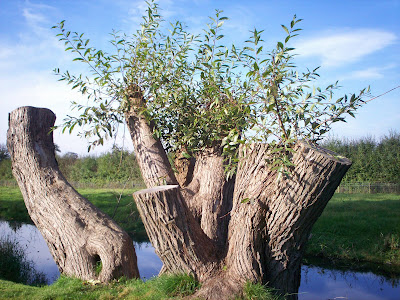
There is hope for a tree:
If it is cut down, it will sprout again,
and its shoots will not die.
8
If its roots grow old in the ground
and its stump starts to die in the soil,
9
the smell of water makes it thrive
and produce twigs like a sapling.
10
But a man dies and fades away;
he breathes his last—where is he?

Job is contemplating death and asking about hope. He mentions even trees when cut down can have life again because of water bringing it new life.

As I was thinking about this comparison and contemplating what Job was asking I remembered another place where the bible talks about water in John. This is when Jesus is talking with the Samaritan woman.
John 4:7-14

7 A woman of Samaria came to draw water.
“Give Me a drink,” Jesus said to her, 8 for His disciples had gone into town to buy food.
9 “How is it that You, a Jew, ask for a drink from me, a Samaritan woman?” she asked Him. For Jews do not associate with[d] Samaritans.[e]
10 Jesus answered, “If you knew the gift of God, and who is saying to you, ‘Give Me a drink,’ you would ask Him, and He would give you living water.”
11 “Sir,” said the woman, “You don’t even have a bucket, and the well is deep. So where do You get this ‘living water’? 12 You aren’t greater than our father Jacob, are You? He gave us the well and drank from it himself, as did his sons and livestock.”
13 Jesus said, “Everyone who drinks from this water will get thirsty again. 14 But whoever drinks from the water that I will give him will never get thirsty again—ever! In fact, the water I will give him will become a well[f] of water springing up within him for eternal life.”

This same image is used again in John 7:37, the setting is during Sukkot, the Feast of Tabernacles,
37 On the last and most important day of the festival, Jesus stood up and cried out, “If anyone is thirsty, he should come to Me[f] and drink! 38 The one who believes in Me, as the Scripture has said,[g] will have streams of living water flow from deep with in him.

Jesus compares himself to living water. A water that will quench the thirst or need forever. So the hope that is like water that brings new life to a dead tree which Job was looking for, that we all look for in those times of loneliness and despair, is Jesus.

Matthew 12:21 puts it plainly, “in his name the nations will put their hope.”

Like Job, I have had low points in my life, times when I did not understand why things were happening and even wondering if everything was pretty much over for me. I could not see any light at the end of the tunnel. I had lost my family to divorce, got evicted from my home due to financial issues of the landlord, a few months later lies and false acquisitions cost me my job . It seemed one thing after another kept piling up. I found myself having the similar thoughts to Job. I was not suicidal, but I definitely thought things would be better if I just died so the suffering would just stop and even mentioned that to God several times. The Apostle Paul found himself enduring trial and hardship time and again throughout his life. His philosophy regarding all things in his life is summed up in what he says in Philipians 1:21,

21 For me, living is Christ and dying is gain.

Paul understood that since he had hope in Jesus that as long as he was alive he had a mission to share the hope that he had found in Jesus, and if he died He would live out eternity with Jesus. God reminded me of that during this time and so In the midst of that time, just as in times past and other difficulties since then. I have found my hope in Jesus. Leaning on him I have been able to endure, continue and even go on prosper when it seems everything is against me and there is nothing left for me in life.

Edward Mote composed an amazing hymn that truly sums this point up called My Hope is Built on Nothing Less.

1 My hope is built on nothing less
than Jesus’ blood and righteousness;
I dare not trust the sweetest frame,
but wholly lean on Jesus’ name.

Refrain:
On Christ, the solid rock, I stand;
all other ground is sinking sand,
all other ground is sinking sand.

2 When darkness veils his lovely face,
I rest on his unchanging grace;
in every high and stormy gale,
my anchor holds within the veil. [Refrain]

3 His oath, his covenant, his blood
support me in the whelming flood;
when all around my soul gives way,
he then is all my hope and stay. [Refrain]

4 When he shall come with trumpet sound,
O may I then in him be found,
dressed in his righteousness alone,
faultless to stand before the throne. [Refrain]

The most amazing thing about this hope that is Jesus, is it is for everyone. There are no requirements other than you ask for it.
This hope never runs out, it never grows smaller, because God is a God of more not less . When Israel was rebuilding the temple and everything was in ruin and looked as thought it could never be rebuilt, God sent a word to them through Haggai saying (Haggai 2:9)
9 “The final glory of this house[b] will be greater than the first,” says the Lord of Hosts. “I will provide peace in this place”—this is the declaration of the Lord of Hosts.

He was telling them that there was still more hope, it had not passed them by. That same idea is true for us as well. When God brings hope and restoration he does not short change us. He is a God of more. In my own life he has restored and brought me a wonderful wife who is also seeking after God, blessed me with more children, a steady job and many other blessings.

God brought restoration to Job because of his continued faith and Hope in him.

He receives twice the wealth he had before (Job 42:10), plus a new brood of seven sons and three daughters (Job 42:13). Yes his first children are gone forever, our suffering can leave scars, we read that Job’s latter life is blessed “more than his beginning” (Job 42:12), We also know what Job didn’t, that following the resurrection of Jesus that God’s final redemption comes only when Christ returns to bring his kingdom to fulfillment. So not only do we have hope always available in this life, Jesus, the living water, brings life eternal so that hope in him continues even beyond this life throughout eternity. Truly He is a God of Hope.

I want to close with a story about a Christian in church history, a guy named Billy Bray. He was a Miner in Cornwall England and He had one of the most remarkable salvation experiences you ever saw in all of your life. after narrowly escaping a mining accident. Billy Bray was so happy — he shouted and sang all the time. So much so it bothered people. He had so much joy, just shouting all the time. And somebody said to him one time, “Billy Bray, why don’t you tone down some? You’re just too happy. You’ve got too much joy all the time.” Billy Bray said, “I can’t help it. God saved me and I can’t help it. When I put down one foot it says hallelujah, and when I put down the other foot it says glory to God.”

And they said, “Billy, suppose you’re mistaken? Suppose when you die you find out that you’re not going to Heaven after all, you’re going to Hell.” Old Billy said, “Praise God, I’ve been having a wonderful time in the Lord all through the years. Jesus has been good to me and if I die and go down to Hell, then I’ll be thankful for the joy Jesus brought me in life. I’ll shout all over Hell and they’ll have to send me up to Heaven because they can’t stand that kind of joy down there.”

Oh for us all to get a hold of that joy and hope. Hope that brings life just like water does to a tree. To let that hope and joy Joy spill out all over those around us. Who wants that kind of hope and Joy? I know I do.